Ch'an Dao Links:
|
Ch’an Master Nan Huai Jin –1918-2012
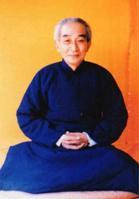
(This short article was written around 2 years before the recent passing of Nan Huai Jin [in 2012]. This English translation is drawn from the Chinese text entitled ‘南怀瑾老师’ (Nan Huai Jin Lao Shi), or ‘Old Master Nan Huai Jin’. He is an important figure in Ch’an history as he is a lay-person who achieved enlightenment after a three-year meditation retreat in the Chinese hills. At the time (in the early 1940’s), he confirmed his understanding by referring to the Sutras of Chinese Buddhism – a common practice even amongst the greatest of Ch’an masters. In 1945 he travelled to Tibet where he studied Kagyu Buddhism, where his enlightenment within the Vajrayana tradition was confirmed by his Tibetan teacher Lama Kunga Hutuktu. He met master Xu Yun through his lay Ch’an teacher - master Yuan Huan-Xian (袁煥仙) – and is acknowledged as a master of Ch’an and Vajrayana Buddhism. Ch’an Buddhism sets-up no distinct between the lay or monastic practice, and strives to reveal the Mind Ground of all phenomena without exception, here and now. ACW)
Nan Huai Jin (南懷瑾) was born in 1918, in the Wenzhou area of Zhejiang province, China. He is renowned as a first class scholar of traditional Chinese learning (国学– Guo Xue), and poetry. He firmly believed that traditional Chinese culture was very valuable and did much to preserve it through his academic teaching career. In the late 1980’s he was responsible for the financing of the Jinhua-Wenzhou Railway, investing much of his own money in the project. His books regarding Buddhism, Daoism and Confucianism are considered amongst the best in the world. Master Nan Huai Jin is a very well respected scholar who has acquired a legendary status in the minds of many due to his profound understanding of Buddhist, Confucian, and Daoist philosophy, as well as his mastery of traditional Chinese martial arts and Ch’an – which he has studied under many great masters. Such mastery has allowed this scholar to live well into his 90’s. One of the secrets to his long life is the practice of only having two hours of sleep per night – from 11pm-1am – and two hours in the day between 11am-1pm. In a 24 hour cycle he only has 4 hours of sleep, but never appears to suffer from sleep deprivation. Indeed, both his spirit and body are very peaceful and yet very strong. A strict adherence to this sleeping pattern has kept his mind and body in a state of constant rejuvenation. Master Nan Huai Jin has said: “According to my observation, which is based upon experience, even if the eyes sleep for only 3 minutes, it is like sleeping for 2 hours. At Noon I must sleep, even if it is only for 20 minutes.” According to master Nan Huai Jin, good health and longevity is the product of continuous ‘cultivation’ (养– Yang) which acknowledges how qi and blood (气血– Qi Xue) flows naturally through the meridians (经脉 – Jing Mai), regulated by regimes of discipline based upon the laws of nature (自然规律– Zi Ran Gui Lu). This requires following the laws of nature so that “If diet is regulated, life will be long.” In this way the mind and body become harmonious. ©opyright: Adrian Chan-Wyles (ShiDaDao) 2012. |