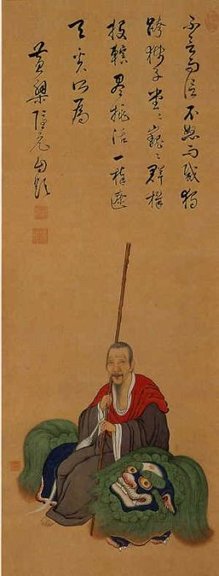
Ch’an Master Yin Yuan Long Qi (隐元隆琦)
- 1592—1673 Chinese Founder of Manpuku-ji Zen Temple in Japan
Translator’s Note:This is an English translation of the
Chinese Language text entitled ‘黄檗山 万福寺’,
or ‘Huang Po Shan – Wan Fu Si’.This is
from a webpage entitled ‘The Official Site of the Joint Council for Japanese
Rinzai and Obaku Zen’.Despite the name,
this webpage originates in China and carries a very comprehensive data-base
dedicated to this form of Japanese Zen.This
website also offers a translated ‘English’ version, but I discovered that in
the case of the text below, much was not translated when using this
facility.I have on occasion accessed
the Chinese Wiki-page for Yin Yuan Long Qi, which contains far more details
about this master’s life, than does the English Wiki-page – the latter of which
can be easily accessed to learn about Yin Yuan Long Qi’s life in China before
he travelled to Japan.When I was younger
and living in the UK, I remember listening to my teacher Richard Hunn
(1949-2006) explain about a ‘Chinese Ch’an temple’ in Japan called ‘Manpuku-ji’,
that he routinely visited in Kyoto as part of his research regarding the
transmission of Chinese Ch’an Buddhism to Japan – where it became known as ‘Zen’.Of course, he could do this because from 1991
until his untimely passing in 2006, he made Kyoto his home – which he happily
shared with his wife – Mrs Taeko Hunn.Many years later, and after decades of dedicated academic study, I am
now in a position to translate Chinese Ch’an texts into a reasonable English.The translation below is about Ch’an Master
Yin Yuan Long Qi who travelled to Japan in the 17th century and
single-handedly revived the Linji – or Rinzai – lineage of Ch’an-Zen.He is responsible for the building of the
Manpuku-ji, and remains very highly respected figure both in China and Japan.Although much is quite rightly made about his
outstanding poetry and calligraphy skill, one point often missing in other
treatments of his life, is his insistence upon the strict following of the
Vinaya Discipline as the basis of authentic and genuine Ch’an and Zen practice.This is an ideal he shares with virtually all
Chinese Ch’an masters (including the Venerable Xu Yun 1840-1959) and many
Japanese Zen masters, despite the fact that after the Meiji Restoration of
1868, many lineages of the Japanese Zen tradition abandoned the formal
requirement for monks and nuns to adhere to the Vinaya Discipline. ACW 12.8.15
Ch’an Master Yin Yuan Long Qi was a Chinese Ch’an monk who
was known in Japan as ‘Ingen Ryuki’.The
Japanese Emperor awarded him the imperial rank of ‘National Teacher’ (国师– Guo Shi) with the accompanying name of ‘Da Guang Pu Zhao’
(大光普照). Yin Yuan Long
Qi translates as ‘Hidden Essence Grand Jade’, whilst ‘Da Guang Pu Zhao’
translates as ‘Great Light Universal Illumination’.During the latter part of the Ming Dynasty
and early Qing Dynasty, Ch’an Master Yin Yuan Long Qi was officially recognised
as the Linji Lineage (临济宗– Lin Ji
Zong) representative of authentic Ch’an Buddhism, and the 32nd
Generation descendent of that School.Whilst in China, he held the abbotship (住持– Zhu Chi) of the Wan Fu Temple (万福寺 - Wan
Fu Si), which is situated on Huang Po Mountain (黄檗山- Huang
Po Shan).Huang Po Mountain is situated
in Fuqing County (福清县 - Fu Qing Xian), which is in the
Fuzhou Prefecture (福州府– Fu Zhou
Fu) area of Fujian province (福建省– Fu Jian
Sheng), southeast China.
Ch’an Master Yin Yuan Long Qi was invited to travel to Japan
a number of times before finally agreeing to the journey in 1654.His original plan was to spend three years in
Japan, as he was already 63 years old at the time, but as things transpired, he
was to spend the rest of his life in Japan.He left China with 20 disciples and headed east on the ferry-crossing to
Japan (扶桑– Fu Sang).In 1655, the Japanese Zen Master Long Xi (龙溪禅师– Long Xi Ch’an Shi) of Myoshin-ji (Chin: 妙心寺– Mao Xin Si), requested to become a disciple of Yin Yuan
Long Qi.After this, Yin Yuan Long Qi
was highly respected by the Japanese Emperor Go-mizuno'o Tennō (Chin: 後水尾天皇– Hou Shui Wei Tian Huang), and the Tokugawa Shogunate (Chin:
德川幕府的– De Chuan Mu Fu De) - from
the latter of which he received a great gift of land (measuring around 300,000
square meters) to build a Zen temple in Uji (Chin: 宇治– Yu Zhi), just south of Kyoto.During the first year of the Japanese
imperial era (1661-1672) known as Kanbun (Chin: 寬文– Kuan Wen), that is in 1661, Yin Yuan Long Qi supervised
the building of his Ch’an temple in Japan.He did this by planning this new temple along the lines of the pattern
and design of the ancient Ch’an temple in China, situated on Huang Po Mountain –
that is, his old Wan Fu Temple that he had left behind when travelling to Japan.This new temple was situated on a hill in
Japan that he renamed ‘Huang Po Mountain’ (Jap: Obakusan), and he named the new
Japanese temple ‘Wan Fu Temple’ (万福寺) also after his old temple in
China, which is pronounced as ‘Manpuku-ji’ in the Japanese language.The temple name ‘Wan Fu-Manpuku’ translates
as ‘Ten Thousand Blessings’.When the
building was complete, Yin Yuan Long Qi was installed as the temple’s first
abbot.
Master Yin Yuan Long Qi was very successful in his propagation
of the Ch’an-Dharma in Japan.Such was
his very good reputation as a Ch’an monk that he attracted thousands of monastic
and lay disciples, and encouraged interest amongst the general public in the Ch’an
method.Among the written works
attributed to him are his books about the correct observation of the Buddhist
Vinaya Discipline (which Yin Yuan Long Qi took very seriously) entitled ‘Great
Precept Law Practice’ (弘戒法仪– Hong Jie
Fa Yi), and ‘Huang Po Pure Buddhist Monastic Rules’ (黄檗清规– Huang Po Qing Gui).Through his insistence that a good Ch’an practice is premised entirely
upon the observance of moral discipline, he managed to revitalise a Rinzai Zen
tradition in Japan that had begun to stagnate over the years.This new moral and virtuous fortitude reawakened
Zen Buddhism in Japan, and its adherents were able to make great progress in
their self-cultivation, and generate good karma for themselves, their
communities, and their country.This is
how the Rinzai tradition of Zen reconnected with its Chinese Ch’an roots in the
17th century, and so strengthened its transmission lineages,
ensuring that this tradition has continued to survive and remain robust down
into the present time.