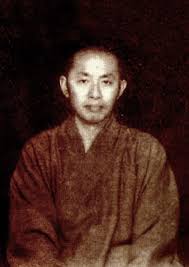
Remembering Dharma Master Ju Zan [巨赞法师] (1908-1984)
Original Chinese Language Text By: Dharma Master Zheng Guo (正果法师)
(Translated by Adrian Chan-Wyles PhD)
Translator’s Note: This is an English translation of the original Chinese text entitled ‘巨赞法师悼词’ which can be translated as ‘Remembering Dharma Master Ju Zan’, or ‘Eulogy for Dharma Master Ju Zan’. This is an undated talk given not long after the passing of Ju Zan in 1984, by another Buddhist monk named ‘Zheng Guo’. Master Ju Zan was held in very high regard not only by Chinese Buddhists (both within and outside of China), but also the Chinese government and the Communist Party of China. He was very well educated and could speak English, which he put to good use in 1931 (the year of his ordination), when he met the first European to be ordained as a Buddhist monk in China (the British-Hungarian known as ‘Zhao Kong’), at the Long Chang Temple (near Nanjing) in Jiangsu province. During the Second Sino-Japanese War (1937-45), Master Ju Zan was very active rallying the people, and administering whatever help he could to the multitude of victims maimed and murdered by the invading imperial Japanese army. In this regard, whilst being a traditionalist in the sense that he thought that Buddhism should be correctly studied and appropriately practised to be effective, he also understood that China needed to be modernised to help the Chinese people attain a better life for themselves, and that Buddhism had to evolve to take into account these changes. This process did not involve the negation of Buddhism, but rather a far more radical and life-affirming re-application of an ancient wisdom to a new set of circumstances. For Ju Zan, Buddhism offered a prime example of the operation of logic and reason preserved within a vehicle intended for self-development and transformation of the individual. Ju Zan extended this revolutionary philosophy (that already included the radical transformation of mind and body), and applied it to the social and cultural environment – thus ensuring that Buddhist thinking adapted to contemporary times, and retained its relevancy for the people of Revolutionary China. It is interesting to note that in the spring of 1949, Master Ju Zan is reported as being in Hong Kong. Master Xu Yun (1840-1959), records in his autobiography ‘Empty Cloud’, that he, too, was in Hong Kong in the spring of 1948/49, and again at an unspecified time of year in 1949/50. It may well be that Ju Zan was in Hong Kong because of Xu Yun, or for the same reason as Xu Yun. For those interested in Master Ju Zan’s recollections of Zhao Kong, please ‘click’ this link for my translation:
Fellow leaders, colleagues and friends, China’s contemporary (and patriotic), venerable old monk named Ju Zan, toward the end of his life, was suffering from a number of ailments, including the atrophy of the nerves in the brain. At that time Ju Zan was confined to his bed, and received the best Chinese and Western medical treatment available, arranged by the government of China (and the Communist Party of China). This meant that whilst he was incapacitated, he was carefully looked after by both Chinese and Western doctors, who worked together to try and save him. Unfortunately, despite this extensive medical attention, Master Ju Zan passed away during the late evening of April 9th, 1984, at 10:10pm. This was considered a great loss to China and the Chinese Buddhist cause. Such was the power of Master Ju Zan’s virtue, that today a great number have gathered here to respectfully mourn his very sad passing.
During his lifetime, he was a Standing Member of the National Committee of the Chinese People's Political Consultative Conference, Vice-President and Deputy Secretary-General of the Chinese Buddhist Association, and Vice President of the Chinese Buddhist College. He also served as Chief Editor of the monthly ‘Modern Buddhist Studies’ magazine, as well as performing many other duties. Dharma Master Ju Zan was born in 1908 in ‘Guan’ (贯) Village, situated in the Jiangyin County area, of Jiangsu province. His lay surname was ‘Pan’ (潘), his first names were ‘Chu Tong’ (楚桐), and he was commonly known as ‘Qin Pu’ (琴朴). In his youth, he graduated from the local Jiangyin Normal School, before studying at the Shanghai Daxia University. In 1938, in the Hunan area, Master Ju Zan organized the ‘Nanyue Buddhist Relief Association’ and the ‘Buddhist Youth Service’, to assist in the Anti-Japanese National Salvation Movement. In 1940, Master Ju Zan became the General-Secretary of the Guangxi Buddhist Association, and the editor of the ‘Lion’s Roar Monthly’ magazine, which actively campaigned in support of the anti-Japanese war effort to save China from destruction. In 1942, Master Ju Zan became the ‘Head Monk’ (住持 – Zhu Chi – or ‘Upholder of Life’ – usually rendered ‘abbot’ in Western discourse), of the Dragon Brilliance Temple (龙华寺 – Long Hua Si), in the Mount Xi area of Guiping County, situated in Guangxi province. In 1944, Master Ju Zan was a teacher at the Wuxi Guoxue Technical College, situated in the Bei Liu area of Guangxi province. In 1946, Master Ju Zan returned to the Spirit Essence Temple (灵隐寺 - Ling Yin Si) in Hangzhou, and then became the Secretary of the Buddhist Association of Zhejiang Province. In 1948, he was appointed dean of the Wulin Buddhist College in Hangzhou, and was then invited to Hong Kong to give lectures, and to assess the situation of Buddhism in the Taiwan province of China. He spent that winter in Hong Kong, before travelling back to Beijing in the fourth month of 1949, to personally welcome the founding of New China.
After Liberation, Master Ju Zan ended his life as a wondering monk and settled in Beijing, becoming very active in support of the People’s Government (and the Communist Party of China), rebuilding the country, leading the Buddhist community, assisting in the development of a modern Buddhist education system that included generating patriotic love and support for the country, and cultivating a willingness to participate in hard-work. During the 9th month of 1949, Ju Zan attended the first session of the Chinese People's Political Consultative Conference. In 1950, Master Ju Zan founded the Great Heroic Sack Factory. He encouraged Buddhist monks and nuns to dedicate a part of their day to manual labour, whilst participating in the launch of the modern Buddhist Studies Society. This was when he became the Chief Editor of the monthly ‘Modern Buddhist Studies’ magazine. In 1952, Master Ju Zan dedicated his time to establishing a new Chinese Buddhist Association, and did much of the planning and preparatory work himself. From 1953 until his death in 1984, Master Ju Zan dedicated his life to applying correct leadership, attending important conferences and devising Buddhist educational programmes suitable for people living in a modern society.
Since his adolescent years, Master Ju Zan partook in patriotic activities. He was particularly inspired by the ‘United Front’ policy of the Communist Party of China – which called upon all Chinese people to unite and defend the country against imperial Japanese aggression. At this time in the history of China, Master Ju Zan was deeply moved with compassion for the suffering of the people throughout the country, and arranged Buddhists into local groups of mutual assistance, labour activity, self-defence and resistance, in such places as Hunan, Nanyue, and Changsha, etc. As the editor of the ‘Lion’s Roar Monthly’ magazine, he called for all Buddhists in China to unite as a patriotic duty to defend the motherland from Japanese imperialist aggression, and to actively assist the Chinese fighting forces wherever they could in this sacred duty. He emphasised the ‘selfless’ nature of Buddhism, and clearly pointed-out the egalitarian nature of its teachings. On the eve of the founding of New China (in 1949), Master Ju Zan hurried northward from Hong Kong to Beijing, eager to assist in the Socialist reconstruction of the country. For more than 30 years after the liberation of China, Master Ju Zan unswervingly adhered to the path of study, self-cultivation, patriotism, (and support for the Socialist Path, which he thought was compatible with the Buddha’s teachings). Even during difficult times of turmoil and confinement (1966-1976), he never gave-up the belief that China needed to be modernised for the welfare of the people, and for the preservation of Buddhism. Master Ju Zan, in his later life, worked steadfastly to reunify Taiwan and Hong Kong with the motherland, as he missed visiting these places and teaching Buddhism.
Master Ju Zan spent over 50 years practising Buddhism during his lifetime, and thoroughly studied the Tripitaka in considerable depth, whilst fully adhering to the upholding of the Vinaya Discipline. Master Ju Zan followed the method of correctly learning about Buddha-Dharma, and applying that knowledge to a sound meditative practice (to gain entry into a profound conscious development). In this regard, he studied the ‘Three Treatises’ (三论 – San Lun), the ‘Divine Sky Platform’ (天台 – Tian Tai), and many of the teachings of the virtuous and just ancestral masters of old (whether Buddhist or non-Buddhist). Whatever subject he studied, he mastered fully and without error. With regard to his Ch’an studied, he was very strict in its practice, and spent many years returning the mind to its empty root and transcending duality, without being attached to any limited notions of Nirvana. This is how he transcended the deluded root of life and death. Due to the broad nature of his knowledge and wisdom, Master Ju Zan for a number of decades, published academic articles upon the history of Buddhism and Buddhist practice (as well as non-Buddhist subjects), in both Chinese publications, and publications abroad, such was the high regard with which his compassion and wisdom was held around the world.
It must be remembered that Master Ju Zan possessed an excellent all-round and extensive education that not only covered Chinese Buddhism, Daoism and Confucianism, but which also included the numerous schools of pre-Qin, Song and Ming Dynasty philosophies and interpretations. Not only this, but Master Ju Zan was also an expert in China of Western philosophy, particularly that related to Kant and Hegel (which has relevance for interpreting the Buddhist teachings of ‘form’ and ‘void’, for those not familiar with the subject). He tended to emphasis an eclectic approach to understanding, that although diverse on the surface, shared a common root of the mind essence (and its realisation through Buddhist practice). His area of expertise also included Traditional Chinese Medicine (TCM), qigong, and the philosophy of yin and yang – subjects within which he had many profound insights. However, Master Ju Zan always used the Buddhist method of mind development and realisation as a foundation to bring all this understanding together. This approach effectively created a profound and effective interface between the old and the new, and between the east and the west. In this regard, the place of Master Ju Zan within modern Chinese Buddhist history cannot be over-emphasised, as it was his example that demonstrated to many intellectuals how the limitations of the past could be thrown-off, whilst retaining the wisdom of the past for application to a modern world. He also showed how non-Chinese philosophies could be learned and applied to a modern Chinese cultural setting.
During his involvement with the higher echelons of the Chinese Buddhist Association, Master Ju Zan campaigned for unity amongst all of China’s ethnic Buddhist groups, and for those groups to support the government of China in its reconstruction of the country. He did this whilst simultaneously advocating the establishment of the principle of freedom of religious belief, which the Chinese government implemented without hesitation. Master Ju Zan was of the opinion that religious freedom in China would serve as the basis for the unity of the people. To demonstrate the efficacy of this policy, Master Ju Zan played an active role in pursuing Buddhist academic research, publishing Buddhist books and journal articles, as well as establishing Buddhist colleges and universities, designed to carry forward the fine traditions of Chinese Buddhism. He further organised Buddhists to help their local communities through participating in Socialist reconstruction projects. Another interesting policy pursued by Master Ju Zan was the uniting of overseas Chinese people with the people in China, using the practice and study of Chinese Buddhism as common ground. He even managed to extend this project to include international Buddhists from various countries, many of whom were sympathetic to New China, and possessed an interest in the study of Chinese Buddhism. The importance Master Ju Zan’s work cannot be emphasised enough, as it served to connect New China with the outside world, during a time of diplomatic isolation.
We gather here today to mourn the passing of Master Ju Zan, and to remember with respect the great reputation of this most progressive of Buddhist masters. However, we should not dwell in sadness, but be inspired by the example he set. He always advocated a responsible attitude of diligent and conscientious work – if you are able - do as much for others as it is possible to do, and do not passively wait for others to do things for you. Help wherever you can, but always keep a calm and peaceful mind and body. Support the government of China by explaining the naturally egalitarian aspects of Buddhism, and always align the Buddha-Dharma with the principles of Socialism. Never allow discord to develop in the mind, body, or environment. Always maintain peace and harmony in whatever you do. We must, as Buddhists, adhere to Master Ju Zan’s progressive work as we move through the 1980’s, bringing to fruition the many projects he actively encouraged and pursued. This behaviour will bring comfort to Master Ju Zan – who now abides in the silent light.
Respect wisdom, whilst preserving and transmitting this text!