|
Author's Note: Dear reader - I sincerely hope the following causes your mind to be both "socked" and "doubt" infested. After-all, you are not paying me for a service and I am not selling you any wares. Of course, we could dance this dance - as the internet is default set for commercial endeavour - but Ch'an is not that easy. It would be easy for you to give me money (and purchase my compliance) - but it is not so easy to permanently give away your greed, hatred, and delusion, ad clearly show me the empty mind ground. This is why the Ch'an Masters of old resorted to shock-tactics - a shout or a blow - as these actions "halted" the routine thought processes. Today, particularly with regards to writing, the same effect is achieved through the profane treatment of concepts. Fred, for instance, based his entire theory on a defunked (evolutionary) understanding of the development of the foetus in the womb - and when he was told about this - he refused to admit his mistake as his theory had already gained traction in the commercial and academic world. Freud, of course, was Jung's teacher. Becoming entangled in the thing the Buddha advocates becoming untangled from - is not the purpose of Ch'an training. Neither is making you feel "nice" about random words written upon a page. And here we are. ACW (31.10.2025) Having studied with Richard Hunn, I was introduced to Richard Wilhelm’s extraordinary translation of the Book of Changes (I Ching) – which I later learned was originally rendered into Wilhelm’s native German – as the “I Ging”. What were we actually reading? Well, it turned-out that the English translation of Wilhem’s work is in fact a transliteration of his original German version. This might explain why Wilhelm quotes Carl Jung – who was also an ethnic German - although this time born in Switzerland. This is the pathway through which many of us in the West were introduced to Jungian thinking – which I did study for a number of years (although never officially). Richard Hunn had travelled to Zurich as he had been granted permission by Jung’s family to read Jung’s handwritten pages (omitted from his biography) that state he believed that rebirth might be real. His family asked for these pages to be removed as they felt such an idea might negatively impact his more scientific-thinking. Many years later, and after reading Frank J Sulloway’s excellent book entitled “Freud Biologist of the Mind – Beyond the Psychoanalytical Legend” – as well as many similar tomes – I realised just how off the mark this type of (psycho-therapeutic) thinking was - and remains. Yes – such approaches to analysing the mind might assist some people with the negative aspects pertaining to their thought and emotional processes – but such schematics do little more than this. From a Buddhist perspective, it is the “balancing” of the delusional mind-set – or that way of looking at things that aligns greed, hatred, and delusion without ever questioning the presence or validity of these self-defeating entities. Placing aside the scientific issues arising from many of these psychological systems – the fact remains that the “delusional” mind-set as defined by the Buddha is a priori taken as “normal” and beyond any notion of “uprooting” or “transcendence”. Furthermore, linking mind development to commerce adds yet another layer of complication to a process that the Buddha taught free of monetary charge (the cost of training in the authentic Dharma requires a strict self-discipline). Can this type of expedient psychological training be useful? Yes – given that all the conditions are met which produces such an outcome. But here is the massive contradiction to all this. Whereas a Buddhist Master (at least in the Chinese Ch’an tradition) must have attained a confirmed enlightenment before any teaching is undertaken – a psychotherapist can offer counselling when he or she possesses no more or no less mental stability than the next deluded individual. Simply paying for a course of academic training does not guarantee any profound or permanent alteration in the mind of the successful student. This is why many successful academics, even after years of successful teaching (or counselling in the case of psychologists), still retire to isolated Buddhist Temples to eventually get to grips with the greed, hatred, and delusion that continuously plagues their minds. An individual must think for themselves – so that they can permanently “stop” the thought processes on their own and through their own efforts – when given a proper meditative method to work with. This Dharma-process has nothing to do with money or status. Indeed, realising the empty mind ground is perhaps the lonliest undertaking in the world – and so it should be. If Jung had truly realised this understanding, then he would have known that rebirth simultaneously “exists”, “does not exist”, “exists and does not exist”, and “neither exists and does not exist”. There's nothing difficult about that to understand - now is there?
0 Comments
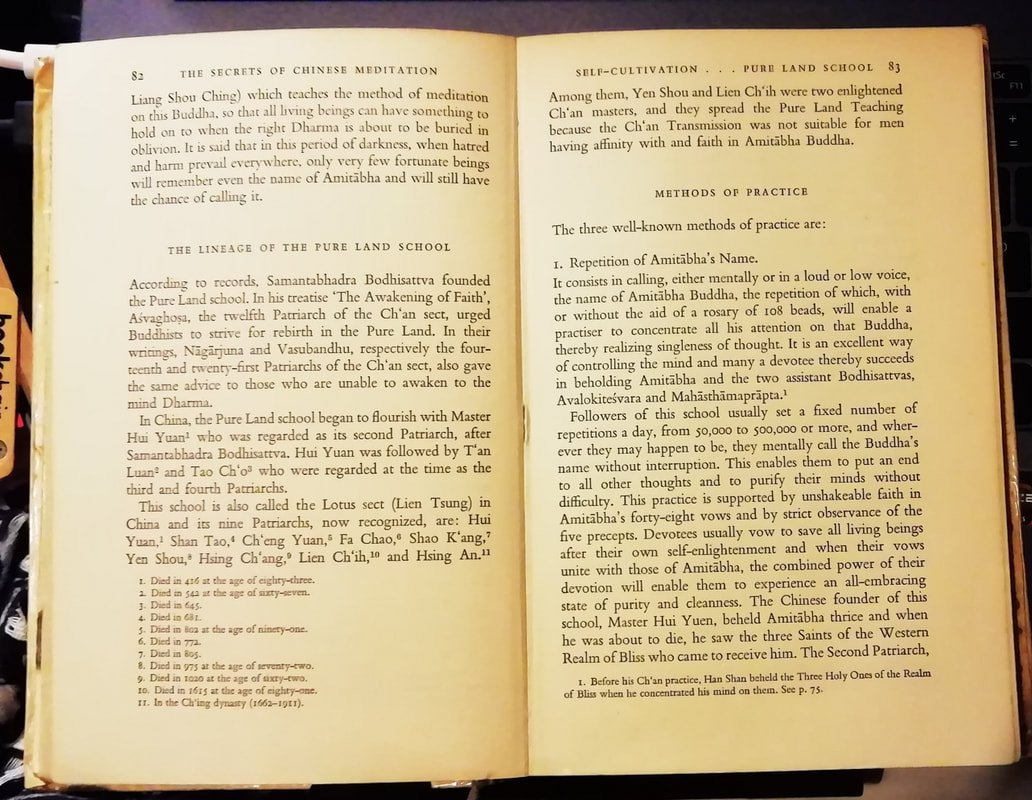
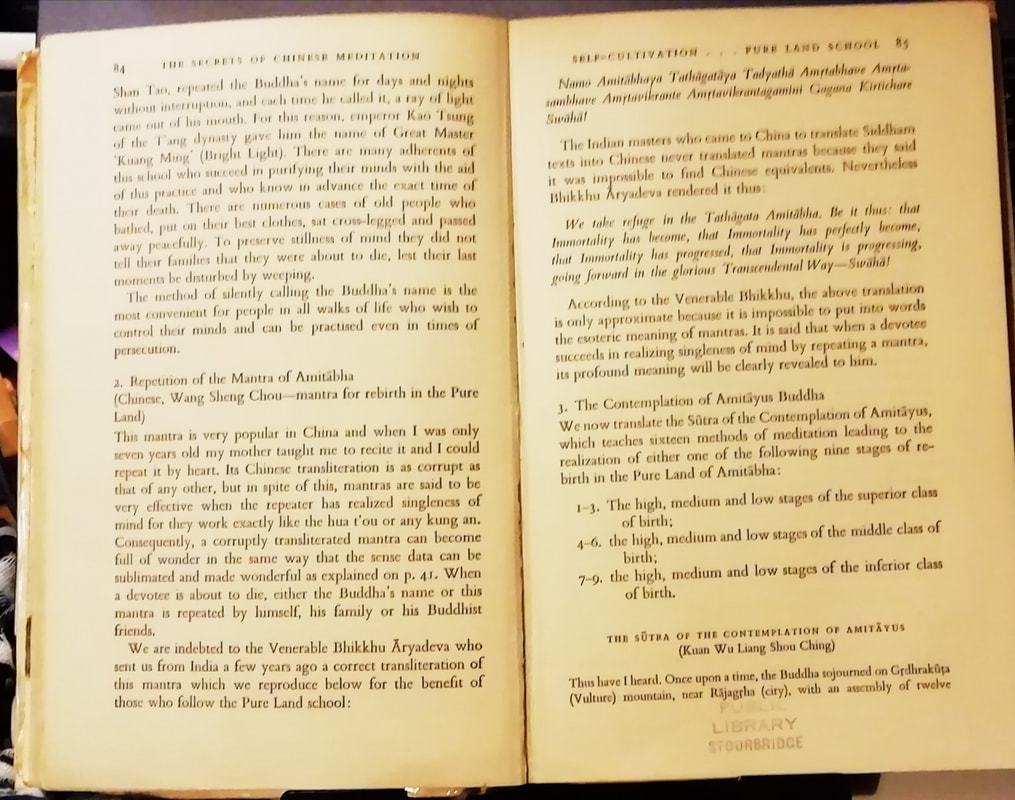
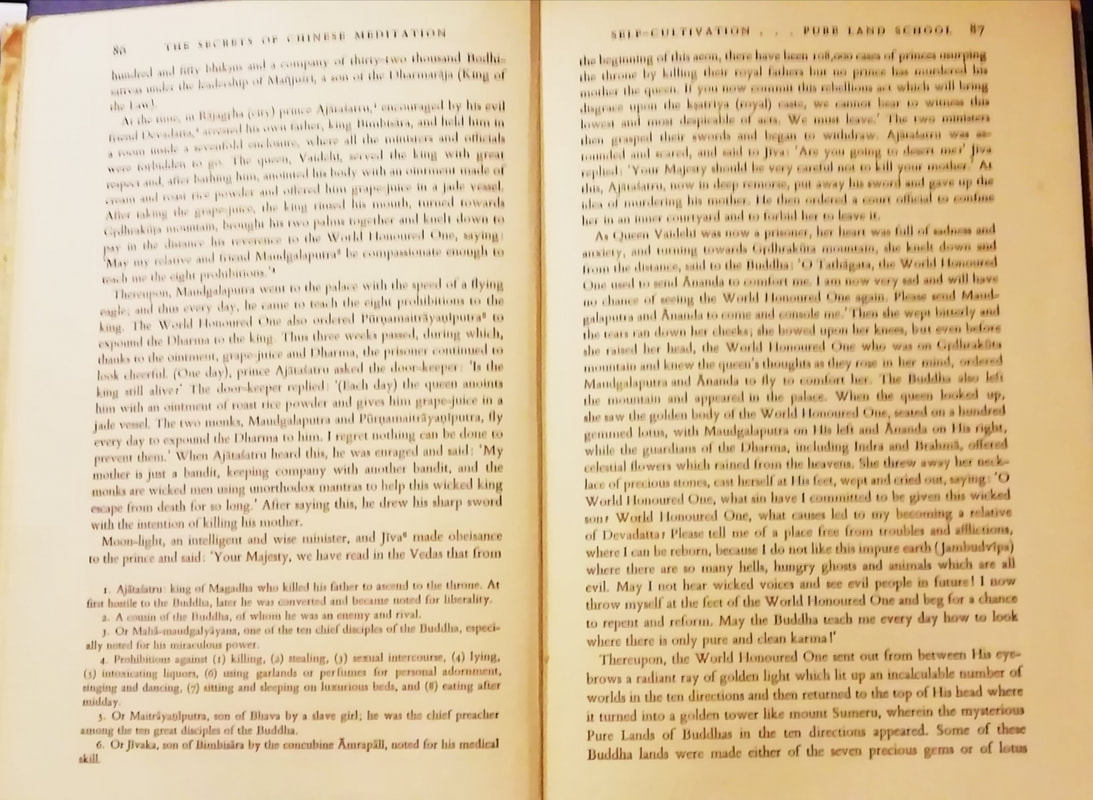
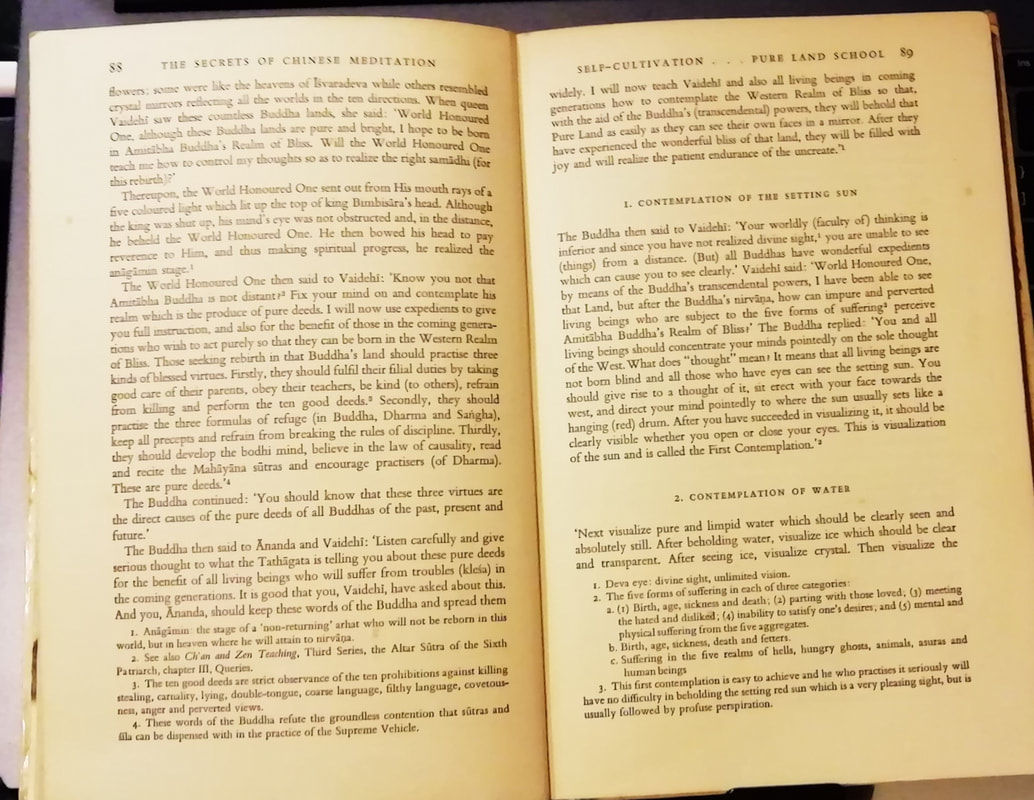
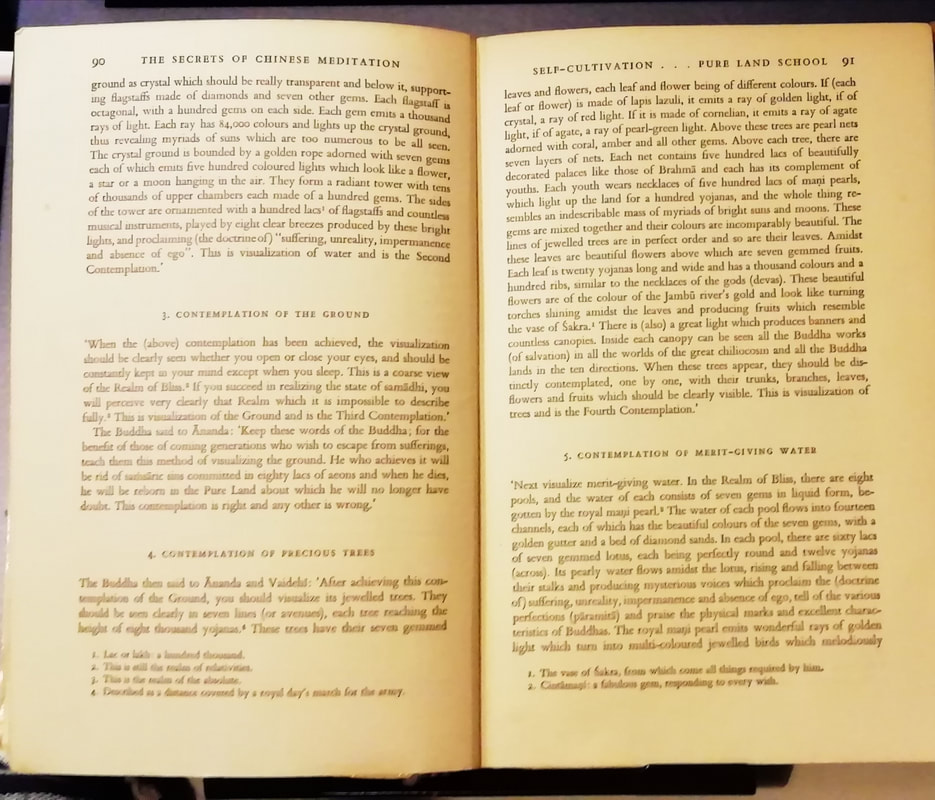
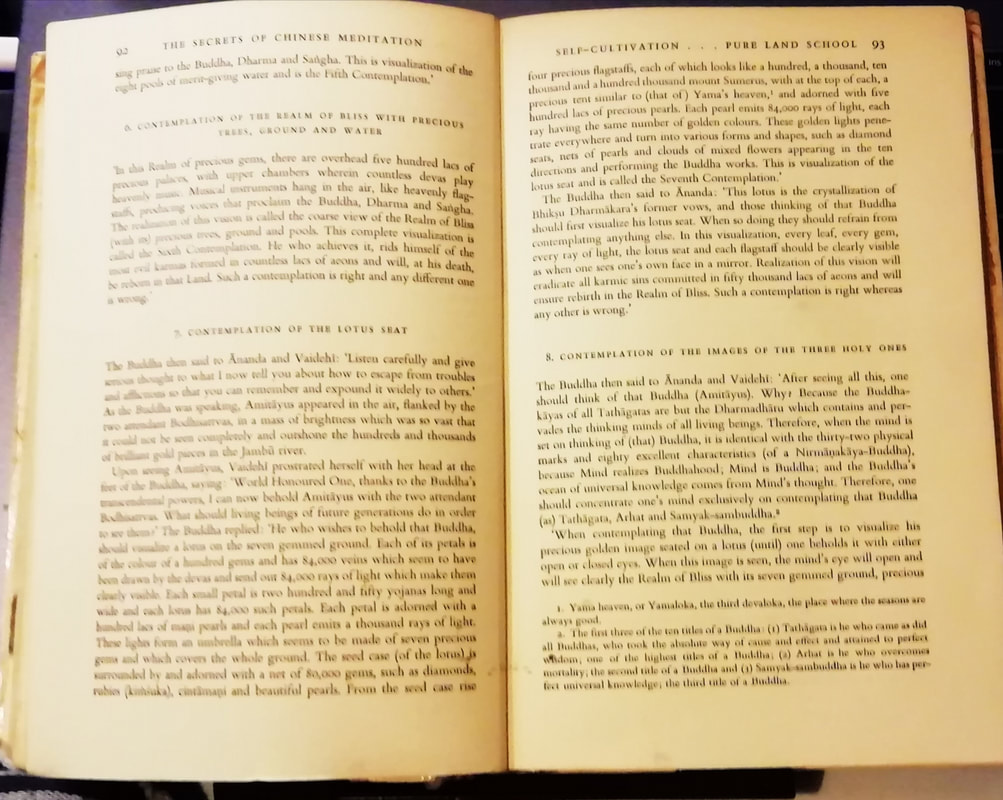
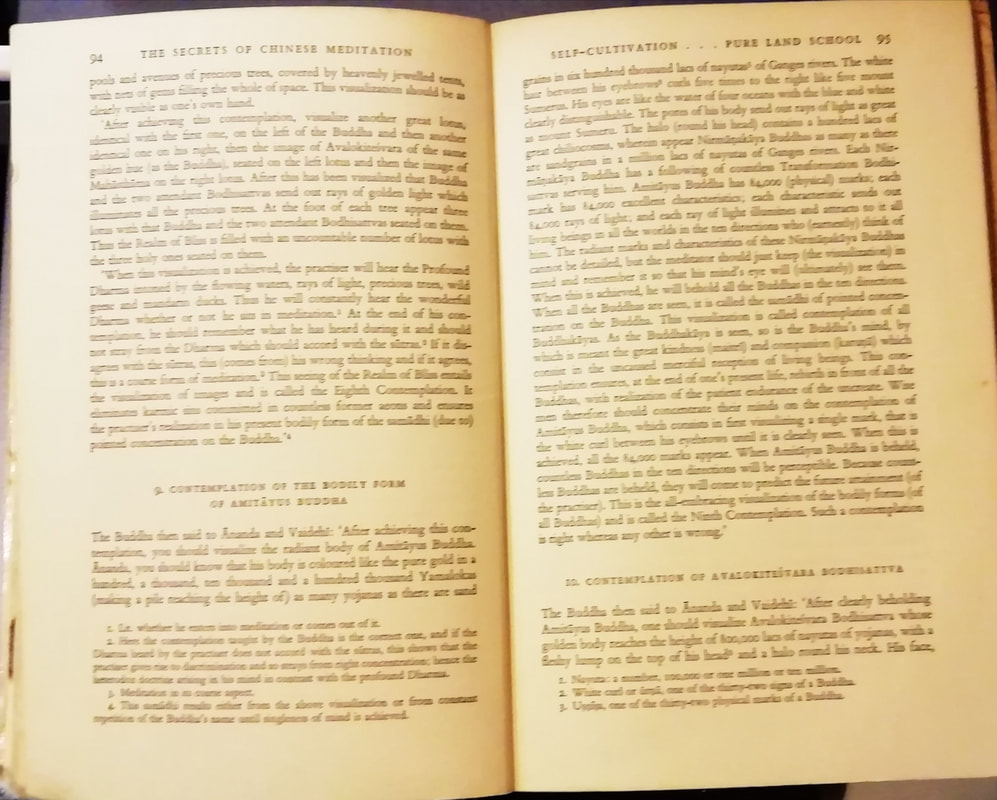
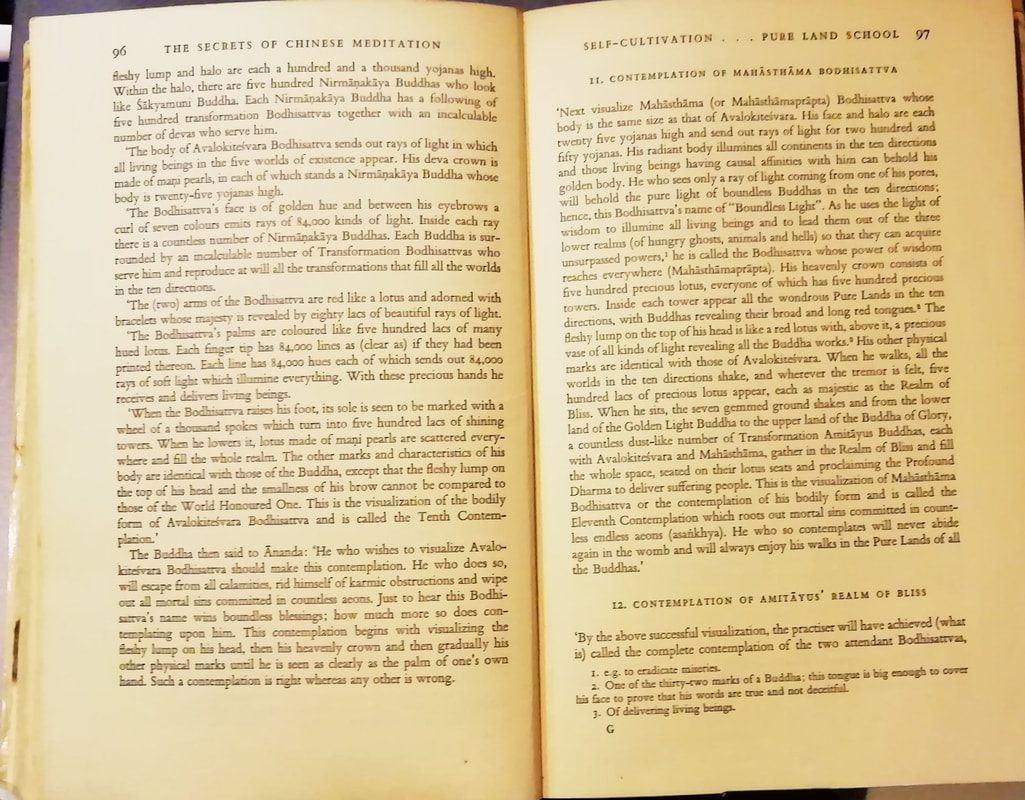
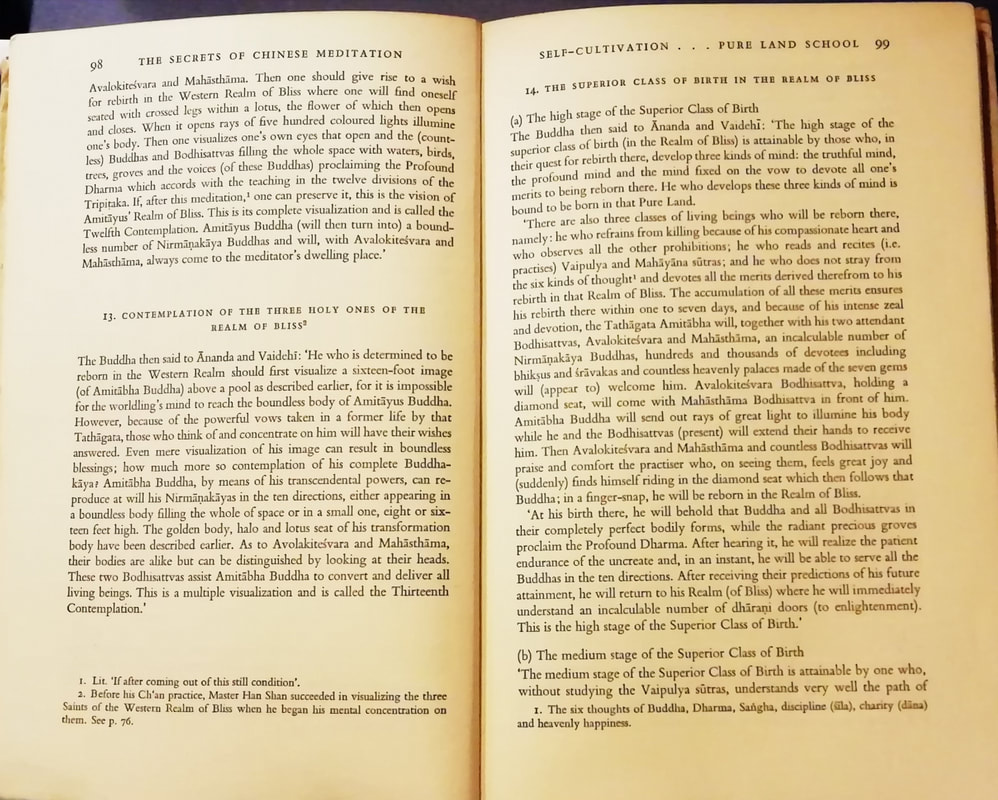
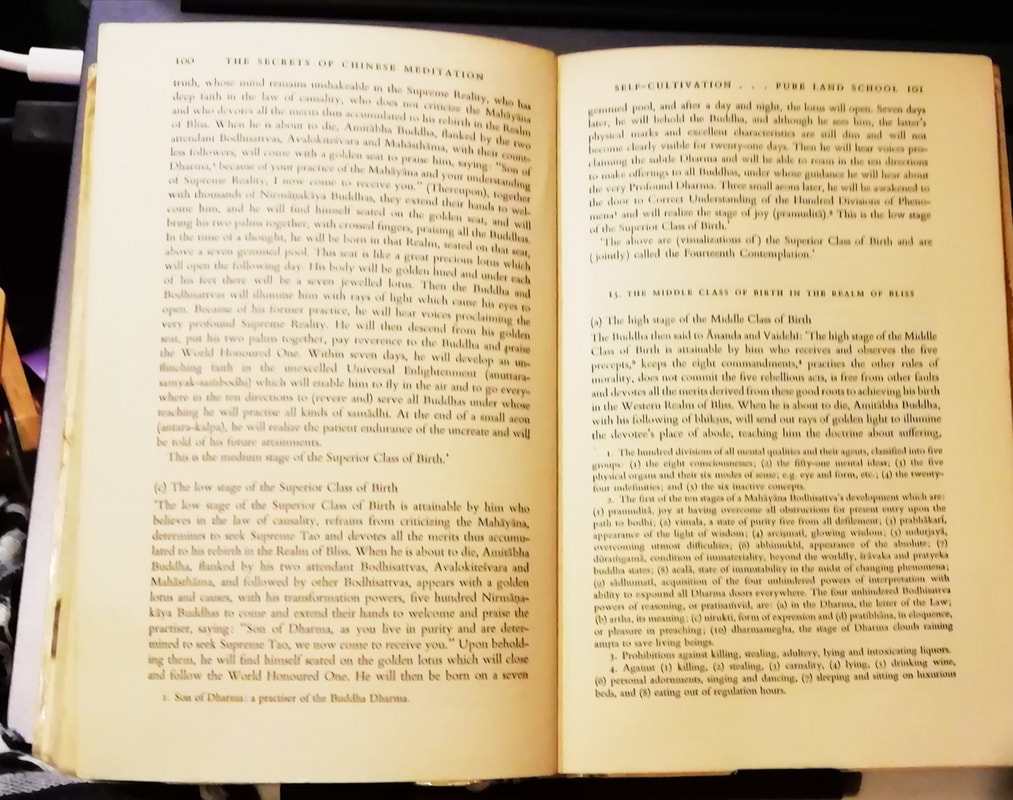
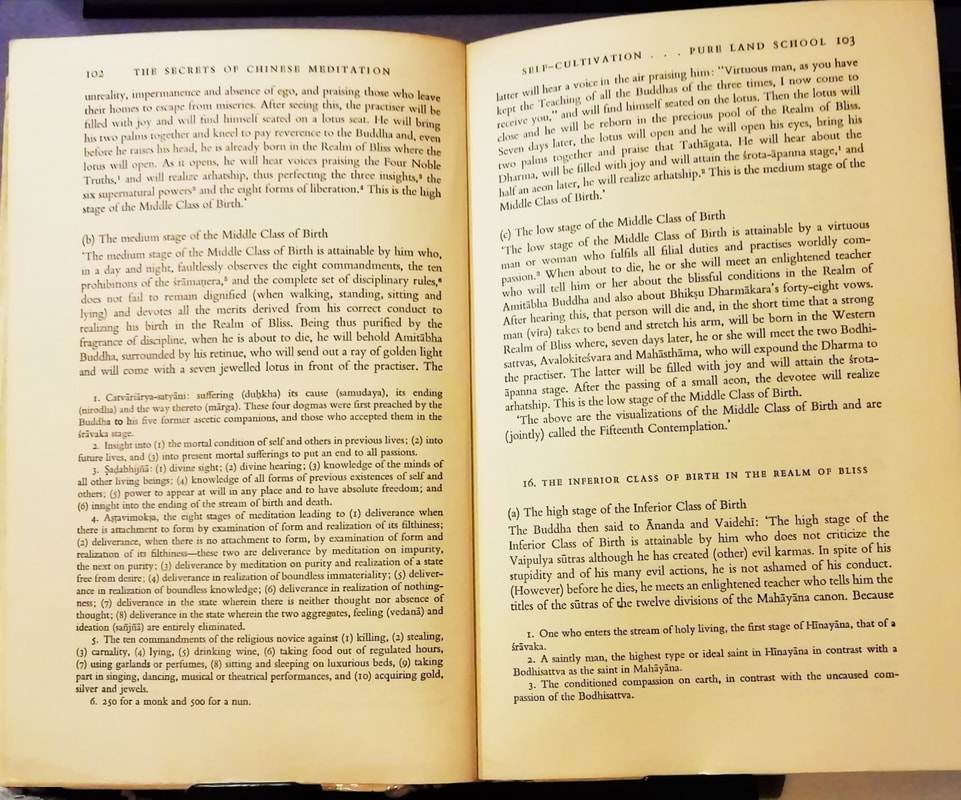
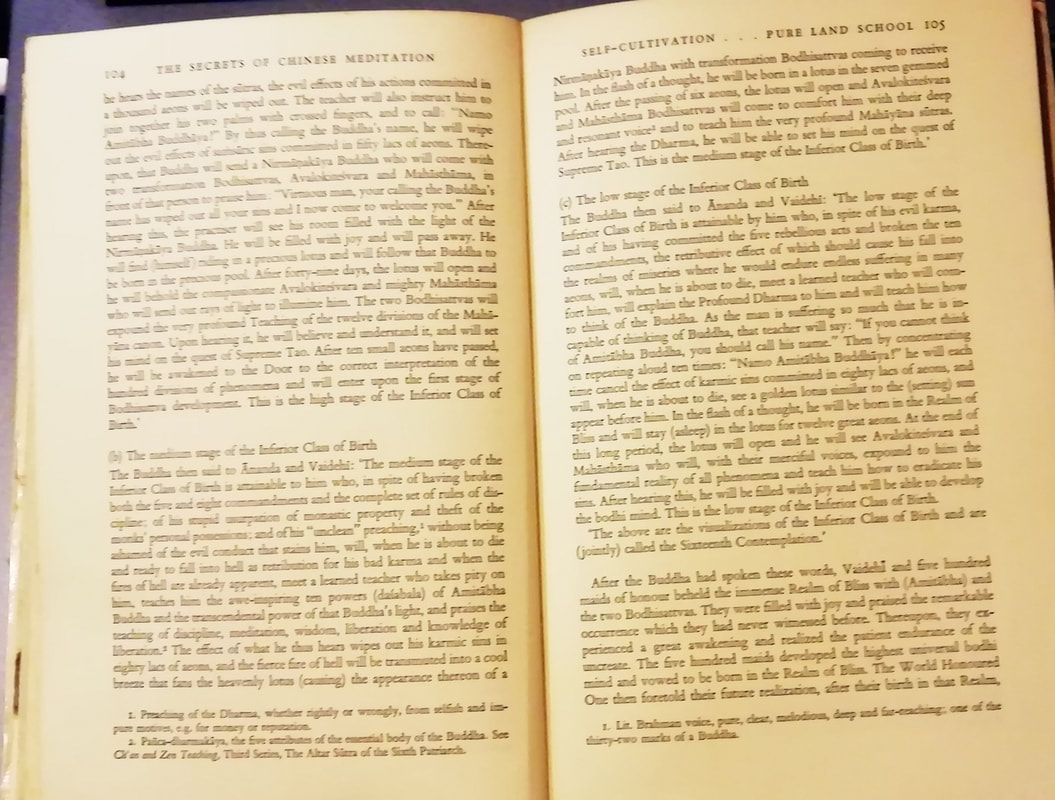
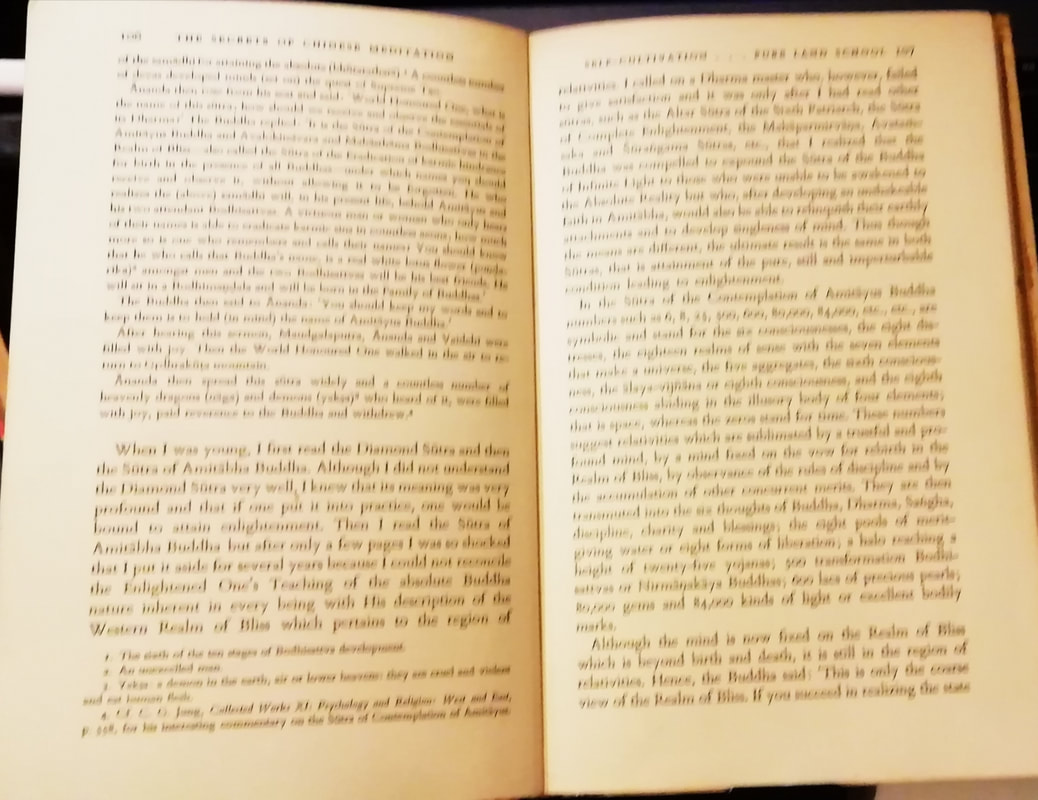
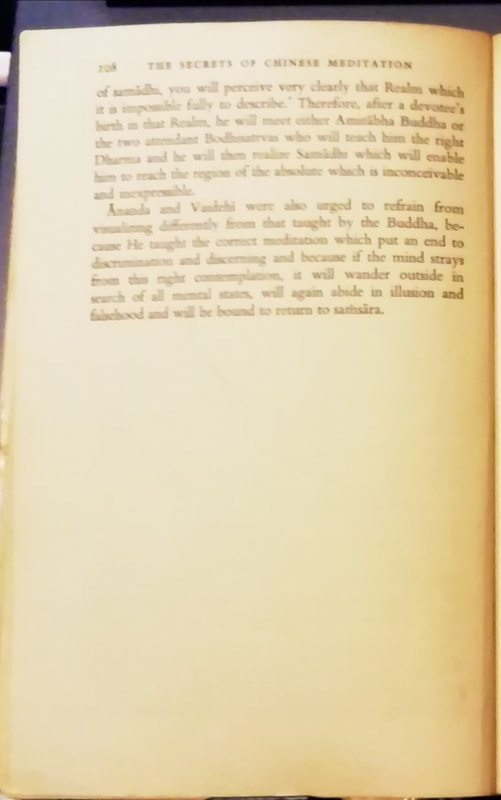
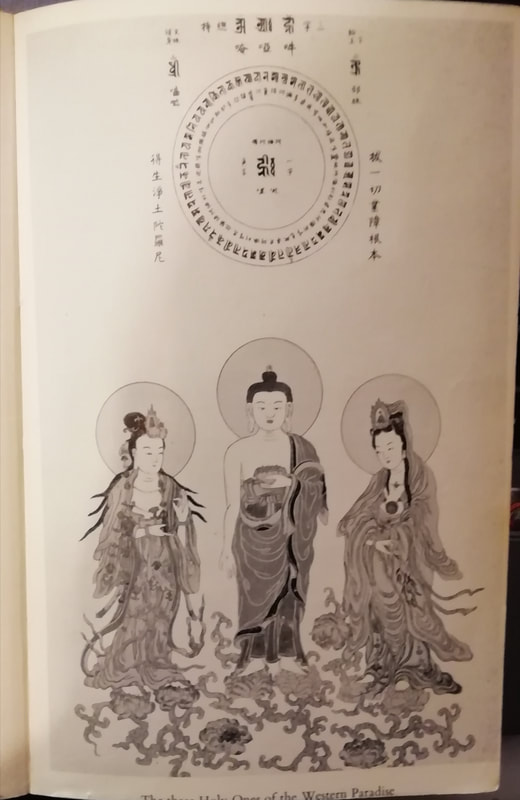
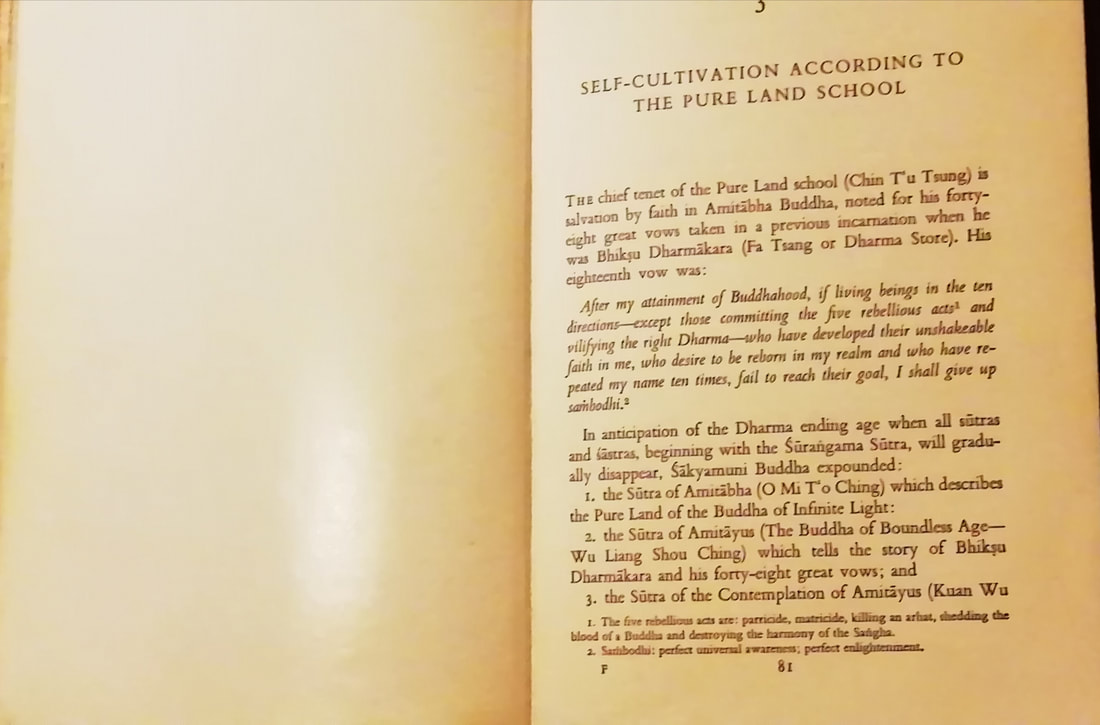
As a number of sincere practitioners have contacted me of late enquiring about the Pure Land Teachings as preserved within China - I have decided to make a simple offering of photographed pages presenting Charles Luk's expert guidance on this matter as recorded in his book entitled 'The Secrets of Chinese Meditation'. I have chosen the original (1964) hardback edition - as quite often later editions were sometimes altered here and there to suit the agenda of various publishers. This is Chapter Three (3) of that book which runs from and to pages 81=108.
‘Drdhamati, even while dwelling in Surangama Samadhi, I am in the trissahasramahasahasralokadhatu and, eventually, in Jambudvipa, I practice, as the case may be, the perfection of (paramita) of giving (dana), morality (sila), patience (ksanti), vigour (virya), absorptive meditation (dhyana) or wisdom (prajna), /In Jambudvipa I am, as the case may be, a recluse with the five superknowledges (pancabhijnarsi), or again, a layman householder (grhastha) or a monk (pravrajita).’ Buddha - Surangama Samadhi Sutra (Lamotte – 1998 – Page 197) We all experience birth and we all experience death. These are two guaranteed events in our lives that apply equally to everyone regardless of our genetic inheritance or the life circumstance we are born into. Death can be further subdivided into a) natural and b) unnatural. Natural death to that shutting-down of the biological life-sustaining processes at the end of a long life, or at anytime on life's journey that does not originate from accident, illness or violence, etc. A 27-year-old, for instance, can pass away quite peacefully in their sleep simply because their particular genetic clock decides to 'switch' their heart off. This may be to do with the past evolution of human-beings when our distant ancestors did not live much past twenty. An 'unnatural' death is a demise due accident, illness or violence. This is when an individual's life-span is cut-short due to a malfunctioning body (as in any number of genetic illnesses), or suffers the destruction of organs due to an accident. Violence committed by other humans can often account for many such deaths such as through pointless attacks within civil society, murder, acts of terrorism and acts of war. This category can be extended to include economic violence where people are deprived of work, income, food, clothing, education and medical assistance, etc, due to an ideology that privileges a few over the many. This also includes the the concept of 'psychological' violence which can serve as the base cause of all types of mental illnesses and later aberrant actions premised upon their numerous cognitive dysfunctions. Buddhist philosophy adds another layer to all this in the form of individual and collective karma. The Buddha stated that not everything we personally experience and suffer has a root cause in volitional karma. Cancer, for instance, can be the product of a poor lifestyle and deficient choices in diet, activity and social setting, etc, but it can also be the product of the simple misfunctioning of a body cell with no input whatsoever from volitional karma. In the latter case, Cancer is a 'naturally' unfolding process. This is like the changing of the seasons or the rising of the sun, not much can be done about it at the individual level other than to 'observe'. Furthermore, at the point of full enlightenment, the Buddha states that the ridge pole of ignorance is forever broken and that the concept of karma (and notion of rebirth) comes to an end. Following all the quarantine and cleanliness rules in this current climate will help increase the chances of us as individuals not contracting, passing on or possibly dying from Covid19. From a Buddhist perspective, it is that simple.
Dear B
The Buddhist Sutras state that at the point of enlightenmet realisation - all karmic activity ceases and all gods-goddesses are understood to be non-existent. Indeed, the only karma left is the lifespan of the current human-body - which must be lived-out - but with any potential (debilitating) effects greatly diminished through the - volitionl capacity of subject-object attachment - being transcended. Of course, this matter is complicated by the Bodhisattva principle which states that an appropriate 'deluded thought' is produced at the point of physical death so as to initiate yet another bodily existence (through force of habit) - which is selflessly used to help all other life-forms - whatever they may be (human, animal, environment and alien, etc). Pali scholars suggest this Mahayana teaching is 'nonsense' - whilst Mahayanists consider it natural and inevitable - take your pick. However, when an existence is completely 'finished' (as with Buddha and Master Xu Yun) - the individual concerned enters 'parinrivana' and that is very much that. Remember, the gong-an (koan) literature contain a wealth of wisdom regarding these matters. When enlightened Masters are asked what they have been practicing of late - they often reply 'not even the four noble truths.' Why practice an expedient teaching when one's mind (and body) exists in a permanent state of integration with the ultimate position (i.e. the 'empty mind ground')? What happened next? Richard Hunn had talked about separating the ‘bodhis’ from the ‘klesas’ - but like much of his method, a pristine insight was delivered through a typical British sense of humour. He also said that an individual must not be attached to the void nor hindered by phenomena, and that an indeterminate period of further training was required. Within Ch’an training, often it is the case (but not always) that ‘klesa’ still bubble-up to the surface of the mind post-enlightenment, where they can be harmlessly ‘dissolved’ through the power and strength of meditative insight (prajna). What are ‘klesa’? Klesa are psychological and emotional distractions of various strength, thought to be the product of eons of generating thoughts premised upon greed, hatred and delusion, through the filter of subject-object duality. In modern terms, this is the disrupting (and potentially damaging) reactions in the mind that respond to, and condition further actions and reactions in the physical environment. If a strictly scientific analysis is applied, klesa are the negative thoughts and feelings that cause distress to an individual that have been imported into the interior of the personal mind from the conditioning elements of the collective environment since birth. The Buddha states that a type of rebirth (but not reincarnation) operates within his system, whilst also asserting that at the point of enlightenment (viewed as the stage of ‘relative enlightenment’ as recorded by the ‘3rd’ position of the Caodong School) all rebirth ceases (as the ridge-pole of ignorance is forever broken), and is understood to be non-existent. Therefore, within the enlightened state, rebirth does not exist and only APPEARS to exist in the unenlightened state (probably because it was a common belief in India when the Buddha was alive). Of course, ‘rebirth’ can be imagined as existing as virtually everything can. In this scenario a vivid depository of thoughts may exist in the mind apparently linked to other existences, and this is an experience I have had during meditation (seeing previous existences in China), recognising friends and family around me today, as characters previously existing in bygone lifetimes in different places. The Ch’an method interprets all this as delusion which must be ‘given-up’ if the empty mind ground is to be realised. From 1992 until today (2019) I have been adjusting myself to circumstance. Physical existence appears to be happening within a glowing luminosity, an empty three-dimensional space or void that contains all things. Material objects and the physical world appear real in their own right, but inhabit this infinite, vacuous reality without hindrance or contradiction. Thoughts and feelings yet again move across the surface of the mind but are now both in the ‘present’ and yet fully ‘transparent’. This flow of conscious paraphernalia is no longer hindering or obscuring, but a natural part of physical existence. It no longer possesses historical roots, but appears purely existential in nature (linked entirely to my present and unfolding existence). As time goes by I find myself becoming ever more deeply ‘aware’ of this reality and its processes.
|
Archives
October 2025
Categories
All
|
RSS Feed