
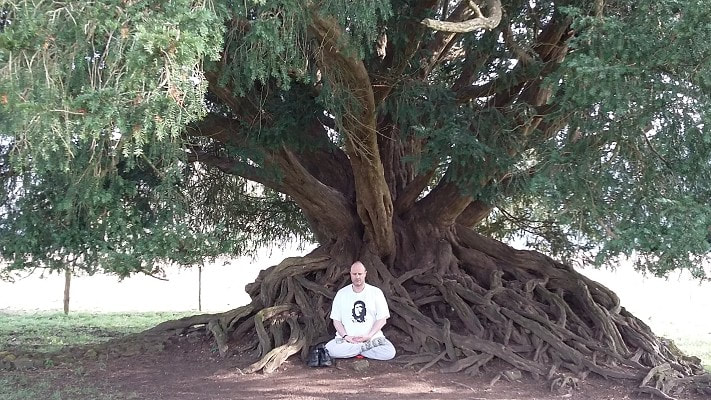
Richard Hunn Never Deviated from the 'Host' Position regardless of the Chaos of the 'Guest' Position!
A number of people have enquired about Richard’s life in the UK pre-1991. Like everyone who lives within lay-society, life tends to have its ups and downs. The life of Richard Hunn was no different. He was born in 1949 – a time in the UK that still had ‘rationing’ and when the country was still recovering from the devastation of WWII! When he passed in 2006, he was 57-years-old and if he were alive today – he would be 71-years-old! The point is that physical life goes on through its various cycles and whether we go on with it is a matter of genetics, personal choices and events in the world which are beyond our control. Richard was married in the UK in the early 1970s and eventually had two children. He had many adventures in this segment of his life and knuckled-down to a) realize the empty essence of his mind under the guidance of Charles Luk (1898-1978) and b) perfect his translation skills of the Chinese language into English. Of course, Master Xu Yun (1840-1959) passed away in his 120th year when Richard was just ten-years-old – whilst Charles Luk passed away at the age of 80-years-old in 1978 when Richard was 29-years-old. Between 1978-1991 (13-years) Richard raised a family and perfected his extraordinary perceptual and linguistic skills. As with many other people living in the world of ‘red dust’ - personal relationships often evolve into new areas of being which no longer involve compatibility on the physical, emotional, psychological and spiritual planes – and this is exactly what happened between Richard and his then partner. Despite going through the turmoil of a failing relationship (which had many peculiar aspects to it) Richard Hunn never once mentioned this when communicating the ‘host’ position to me over a three-year time period.
Always emphasized in his words was the realization of the ‘empty mind ground’ - and nothing else (c. 1989-1991). I would only find out the true extent of the physical chaos when Richard and I became good friends around 2000 (as opposed to just ‘Master’ and ‘Student’), and he would spend hours telling me details to be recorded and stored away for future reference. A young man named Mark Dunlop had escaped from being held as a sex-slave in the bedroom of ‘Dennis Lingwood’ (during the late 1980s) - the founder of the ‘Friends of the Western Buddhist Order’ (FWBO) - and made his way to the Norwich home of Richard asking for help. Following this, the FWBO launched a highly aggressive hate-campaign against Richard Hunn for daring to expose Dennis Lingwood as being a sexual predator. In the 1960s, Lingwood had been an ordained Theravada Buddhist monk in India, but had been caught sexually abusing young boys when he was on the morning begging rounds in the local impoverished villages. The Indian Authorities had him ‘Deported’ back to the UK where Christmas Humphreys (the ‘QC’) and Head of the Buddhist Society used his influence as a freemason to prevent Lingwood from facing the judicial consequences of his crimes. Even today I am contacted by more and more people who have subsequently fallen prey to Lingwood’s sexual offending! As Lingwood lived in the Norwich area – this is where the FWBO Cult was then based (to escape the controversy of Lingwood’s sex-offending, the group has since changed its name to ‘Triratna’).
On top of this, a local Catholic priest had informed Richard’s then partner that the moral safeguards protecting the dignity of individuals in the community did not apply to Richard – as he was a ‘non-believing’ heathen. This allowed any and all kinds of outrageous behaviour to ensue premised mostly upon a mindset motivated by raw ‘jealousy’ and a sense of intense inner ‘weaknesses and lack of ‘self-control’. Although their many incidents recorded, one that stands out is that a rich businessman impressed with Richard’s Ch’an instruction had come to visit Richard in his Norwich home to discuss the handing over of the deeds to a large country house situated in the Irish countryside. The house was to be given to Richard ‘free’ providing it could be used as a Centre for the practice of authentic Chinese Ch’an. The owner had experienced the other schools in the West and found them wanting. As Richard was sat discussing the transaction with the businessman – a loud smashing and crashing could be heard from outside. As the two ran outside to see what was happening – they found Richard’s then partner striking the windows, mirrors and bodywork of the businessman’s brand-new car with a hammer! Of course, the deal with the house fell through!
Always emphasized in his words was the realization of the ‘empty mind ground’ - and nothing else (c. 1989-1991). I would only find out the true extent of the physical chaos when Richard and I became good friends around 2000 (as opposed to just ‘Master’ and ‘Student’), and he would spend hours telling me details to be recorded and stored away for future reference. A young man named Mark Dunlop had escaped from being held as a sex-slave in the bedroom of ‘Dennis Lingwood’ (during the late 1980s) - the founder of the ‘Friends of the Western Buddhist Order’ (FWBO) - and made his way to the Norwich home of Richard asking for help. Following this, the FWBO launched a highly aggressive hate-campaign against Richard Hunn for daring to expose Dennis Lingwood as being a sexual predator. In the 1960s, Lingwood had been an ordained Theravada Buddhist monk in India, but had been caught sexually abusing young boys when he was on the morning begging rounds in the local impoverished villages. The Indian Authorities had him ‘Deported’ back to the UK where Christmas Humphreys (the ‘QC’) and Head of the Buddhist Society used his influence as a freemason to prevent Lingwood from facing the judicial consequences of his crimes. Even today I am contacted by more and more people who have subsequently fallen prey to Lingwood’s sexual offending! As Lingwood lived in the Norwich area – this is where the FWBO Cult was then based (to escape the controversy of Lingwood’s sex-offending, the group has since changed its name to ‘Triratna’).
On top of this, a local Catholic priest had informed Richard’s then partner that the moral safeguards protecting the dignity of individuals in the community did not apply to Richard – as he was a ‘non-believing’ heathen. This allowed any and all kinds of outrageous behaviour to ensue premised mostly upon a mindset motivated by raw ‘jealousy’ and a sense of intense inner ‘weaknesses and lack of ‘self-control’. Although their many incidents recorded, one that stands out is that a rich businessman impressed with Richard’s Ch’an instruction had come to visit Richard in his Norwich home to discuss the handing over of the deeds to a large country house situated in the Irish countryside. The house was to be given to Richard ‘free’ providing it could be used as a Centre for the practice of authentic Chinese Ch’an. The owner had experienced the other schools in the West and found them wanting. As Richard was sat discussing the transaction with the businessman – a loud smashing and crashing could be heard from outside. As the two ran outside to see what was happening – they found Richard’s then partner striking the windows, mirrors and bodywork of the businessman’s brand-new car with a hammer! Of course, the deal with the house fell through!
 RSS Feed