|
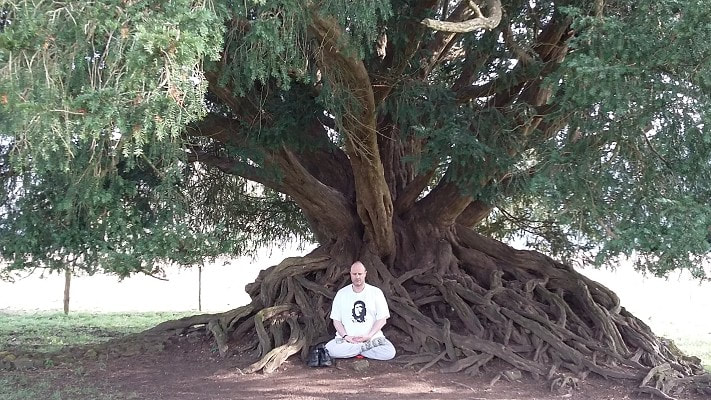
The point is to realise the empty mind ground – here and now – and not be distracted by other thoughts that would divert the practitioner away from this vital objective. On the one hand, there is the cycle of the external world, which quite often requires a type of timed ritualistic behaviour, and then there is the imminant need to focus the attention firmly within, and directly perceive the all-embracing empty mind ground. Which is it to be, outer convention or inner revolution? For Ch’an, the direction is clear – nothing else matters other than the realisation of the empty mind ground. This is the caee despite all living Ch’an Masters occupying a living body that inhabits the material world. The facilitator of the empty mind ground must live by eating, wearing clothes, living within a building, and earning a living, etc. All these things, which includes social, cultural, and political interactions, turn-out to be vitally important on the one-hand – and completely pointless on the other. And yet some type of anchorage in the material world must be established if Ch’an is to be effectively taught. This is a paradox that possesses no single answer. There is no blue-print or set manner in response to this need. How a Ch’an teacher manifests – is how they manifest – and that all depends on the personal situation of the teacher in question. A homeless monk, for instance, can effectively teach, as can an ordinary person, or a person in a high position. Status does not matter. That is merely a necessary window-dressing. What is important is that those who are searching for the empty mind ground must also understand that the expedient circumstances of an effective teacher are irrelevant – if the student can effectively grasp the huatou and decisively “look within”. The reason externality does not matter at this point is that to be overly concerned with externality is to fall into the trap of “attachment” as taught by the Buddha. Attachment to externality is to be ensnared in the distraction of a sideways thinking that diverts from “looking within”. Non-attachment dissolves part of the habitual power of delusion and assists in the clearing of many barriers to achieving inner awareness and profound insight. Of course, once the empty mind ground is fully realised – and the form and void integrated – then the state and function of the external world can be altered for the better using “wisdom” – if such an alteration is required. By 2004, I was discussing with Richard Hunn about the possibility of him relocating back to the UK and living in Sutton – in the same street as my family. At that time, things were very good in the UK, and this idea was a very real possibility. Richard Hunn had lived in Japan since 1991, and had achieved every one of his primary (academic) research objectives. Furthermore, after 13-years in Japan – Richard was beginning to yearn for a return to his native English culture. Not only this, but he very much appreciated the Anglo-Chinese set-up we had going in the Sutton area. The perfect integration of English and Hong Kong culture. Richard Hunn had been teaching English in Kyoto whilst researching the roots of Chinese Ch’an in Japan. This research had been more or less completed by 2004. Richard wanted a return to tea, fish and chips, and Chinese cooking! The problem was that he started to experience alarming health episodes which started off as apparently minor, but got steadily worse - until the terrible diagnosis of terminal cancer during late 2005. Richard opted to stay in Japan and adjust himself to circumstance. This he did until his final breath - taken during October 1st, 2006, whilst sat-up meditating in a Kyoto hospital bed.
0 Comments
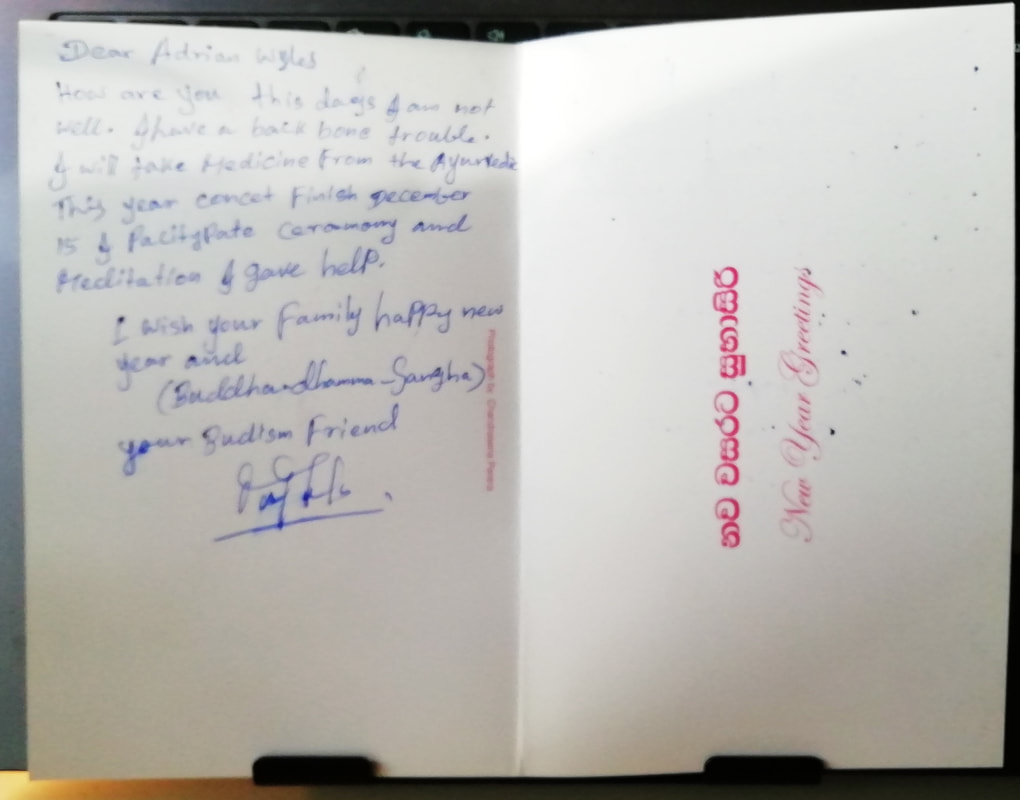
In 2004, the plan was for Richard Hunn to eventually retire back to the UK with Taeko – and live near my family in the sedate area of South-West Greater London we inhabit. Richard liked the area – jokingly saying it was just far away enough from everyone he knew (or was related to)! We had travelled together in car and bus around the local areas such as Kingston-Upon-Thames, Sutton, and into Central London (the latter by Tube). Richard particularly enjoyed having a cup of tea in the "Cha Shop" situated in the centre of Kingston - not far from the ornate Town Hall - and then to visit what used to be the multi-floored (and very well-stocked) "Borders" Bookshop opposite the Square (both now long gone). After visiting the spiritual "Watkins Books" just-off Leicester Square - and eat "Dim Sum" (Yum Cha) in a nearby London Chinatown (Gerrard Street) restaurant. Dim Sum are the special breakfast dumplings (washed down by Green Tea) eaten as part of the TCM recipes that define traditional Chinese food and drink. I think Richard appreciated the "blend" of Western and Eastern culture in a manner unique - and yet typical - to the British Mainland. Richard often explained that when he left the UK in 1991 - he left behind his old life completely and had no idea what the future held. Even I lost contact for a few years - but I did manage to discuss the matter with Richard's ex-wife (Rose) who eventually passed-on a contact address for Richard. I put into practice everything Richard had taught me between 1991-1998 - before I managed to reconnected through direct communication. Richard was pleased with my progress - so perhaps "emptiness" (separation) is good for development! As Taeko’s job (a fashion-industry Executive) – could be performed anywhere – the two were seriously considering this option. Although Taeko had not yet visited our home – she had extensively travelled around the UK. Taeko would only be on familiar terms with myself after the passing of Richard – when such a communication became appropriate. Richard had the idea of living locally and continuing my education on a one-to-one basis. His sudden illness and final demise in late 2006 – came as a shock to us all. At least Richard and Taeko spent the last few years of their happy lives together living in a traditional "Samurai Cottage" in the suburbs of Kyoto. This is why the above plan did not come to pass. I spoke to Richard a few more times via the telephone - and received the odd card (his 2005 Xmas card read "Anything is possible!") - and as I was preparing to fly to Kyoto to be with him during October, 2006, Taeko (and Richard's son - Charles - who was already in Japan) telephoned myself and gave the sad news. Of course, I am not blood-related to Richard Hunn - and it would be highly unethical to give the false impression that I am. No. I am spiritually related to Richard Hunn - and that is enough. I have had the honour to communicate (on occasion) with Richard's flesh and blood - but other than offering my respect and condolences, I did not want to intrude into a highly private matter. In this regard, I remain firmly irrelevant and deep in the periphery - where I belong! Of course, my life had progressed and moved on since Richard Hunn left the UK. I became aware of his presence in the UK via a book entitled "The Buddhist Bible" penned by John Snelling (the "Norwich Ch'an Association" was mentioned - with Richard Hunn quoted in relevant sections) - a British Buddhist who turned-out to be a personal friend of Richard. Although I have only had a nodding relationship with the Buddhist Society (London) - Richard Hunn (and Charles Luk for that matter) possessed a much greater connection. At least tis was true until Richard left the UK in 1991 - when the only spiritual connection would be myself. My position was one of interfacing with the ethnic Chinese community in the UK and Hong Kong - a reality which became far more relevant to Richard once he relocated to Asia. The point is that change and difference are vital for genuine inner and outer self-development. In the end, "change" becomes permanent and an entirely new situation develops. This is exactly the phase we are in today - where the memory and legacy of Richard Hunn has replaced his physical presence. The empty mind ground, however, remains constant just above and behind the movement - as the Six Patriot (Hui Neng) once explained.
Dear Tony Richard Hunn (1949-2006) was both my academic and spiritual teacher. He taught me how read, write and interpret traditional Chinese ideograms. I trained with him between 1989-2006. He was an English gentleman who could read, write and speak many dialects of the Chinese language - including the rare Hakka dialect spoken by our Chinese grandmother (whom Richard met in 2000 during a visit to our house). I wrote this for Richard following his passing: He helped me understand and balance the two sides to my character - the 'Chinese' and the 'British'. He used to work for Pebble Mill (BBC) - but was an academic expert on the Chinese language and Chinese Buddhism. His spiritual teacher was Charles Luk (1898-1978) - who in-turn trained under the Great Chinese Ch'an Master Xu Yun (1840-1959). To me, Richard Hunn represented everything that is great and good about the UK. In 1991, Richard Hunn gave-up his life in the UK and migrated (via a modest academic study grant) to Kyoto in Japan. He lived there between 1991-2006 (marrying a Japanese woman - Taeko - with whom I am still in communication with today). Why did he choose Japan? Well, he received an academic grant to study the transmission of Chinese Ch'an from China to Japan - which included examining the Chinese Ch'an Temples that still exist in Japan - separate and distinct from the Japanese 'Zen' Temples. Every August-September each year, Richard Hunn (who worked at Kyoto University) used to escort a number of his English Study students (usually 20 or so) to look around London. The students would stay for about two-weeks before returning as a group to Japan without Richard. Being 'free' of this responsibility, Richard would visit all his family - before spending a week or two at our house in Sutton (Priory Road - where you showed me an excellent Tensho Kata in the hall). We would meditate together and discuss reality deep into the night. He used to test my understanding of Chinese ideograms - crushing my stupidity and encouraging my insight. Even so, I was reticent to actually 'translate' anything - until a number of Mainland Chinese students studying in the UK checked my work - and encouraged me to start translating. I was then put in contact with a number of academics in China and my life entered a new phase. Richard Hunn visited a number of old martial arts 'Dojo' positioned in and around the remote Kyoto hills. He was often 'Introduced' with a letter to various Old Masters who lived in rustic huts - usually with only one or two disciples. Many practiced Chinese arts unaltered in anyway for hundreds of years. These Japanese men and women also studied traditional Chinese ideograms - the original language of the arts they preserved. As these arts existed 'outside' the grading (coloured-belt) system of Japan - they were excluded from all State financial support - hence their simplistic existence. Best Wishes Adrian
|
Archives
February 2026
Categories
All
|
RSS Feed