Adrian
|
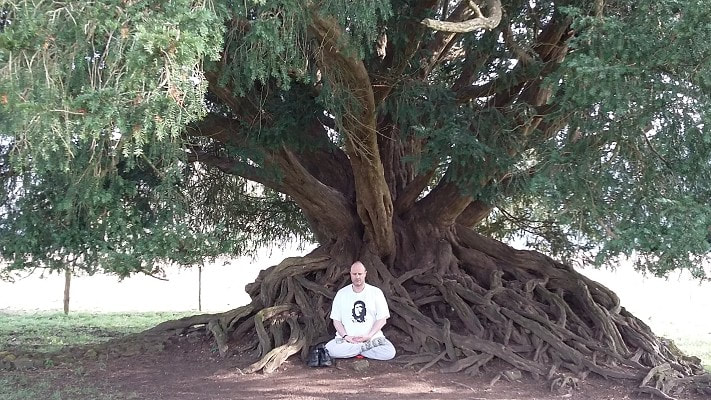
Dear A A story that sometimes comes to mind is something Richard Hunn once told me whilst visiting the UK (from Japan) in the early 2000s. He said that at one time in his life, he was living in a bed-sit - but one where other members in the house used to "walk" through his room during the day or night to access the toilet and kitchen, etc. He said that he used the situation to apply the huatou properly and to a greater depth - outside his comfort zone. He described the people entering, traversing, and leaving his living space as "waves" of phenomena arising, stabilising, and falling apart. He was able to distance himself from his physical surroundings as for most of the time, there was no urgency to "respond" to - or "interact" with - the people or circumstance. He was able to detach from the material circumstances around him - and "look within" - toward the empty mind ground. This is similar to the monastic position where everything is strictly controlled in the monastery - essentially an eternally repeating regimen where all basic needs are met - freeing the mind to move its awareness from the "outside" world to the "interior" of perception. Of course, this changes slightly with the hermit - who might live in a cave, at the foot of a tree, a hut, or some other remote place - free from any external support mechanism. Usually, a young monk trains in a monastery (where everything is provided) and progresses to living alone (with no support mechanisms). Perhaps this is a progression to moving away from predicting or relying on preconceived outcomes. Lay and monastic are two-sides of the same coin with the empty mind ground underlying both manifestations (Vimalakirti). Again, "Neither attached to the void - or hindered by phenomena". The question becomes one of path of access - but the method (returning thoughts to their empty essence) is the same. Within China, the "Dao" (Way) is used interchangeably to refer to the "path" and the "destination". Sometimes, this distinction is subtle and the nuance is lost in translation. Still, Charles Luk, who read copious amounts of Daoist texts, and was of the opinion that the Dao De Jing is the essence of all Daoist teaching. Placing the opening chapters into into a coherent and relevant English-language context is still an ongoing process. Many shuffle the words around - copying one another's translations. The assumption is that what came before is "correct" and that these conventions simply require re-organising. The problem is that these "assumptions" may not be correct, precise, or even relevant. First principles must be re-established time and time again as a better understanding develops. Many are surprised, as they understandably work from a select number of translations - forming an integrative understanding - but when they see the original Chinese text and look at the literal meaning, quite often there is a slippage of meaning. The problem with personal development within Ch'an is the detaching from the external, the penetrating of the empty mind ground within, and then the integration of the two - which is easier said than done. Many ignore this difficulty as its recognition might take away the momentum of developmental purpose. Even after penetrating the empty mind ground - and when living in the material world - "klesa" (defilements) bubble-up in the mid-mind (that is the cognitive space between the empty mind ground and the material world of perception in the fore-mind) as responses to phenomenal reality. These reactions, as you know, are good, bad. and neutral, and the bread and butter of everyday life. In other words, the waves of "change" are incessant, ongoing, and never-ending.As they unfold - we change and mature. Experience equals process. It is interesting that when people meet - they swap stories of "change" - perhaps this is the currency of human communication - and the reason the ancient Chinese people developed an entire Classical Text dedicated to its interpretation. The main text of the Book of Change (Yijing) the oldest parts - do not use the term "Dao" - which begins with the Commentaries associated with Confucius (or his disciples and followers - perhaps even relatives). I suppose everything has an origin. Best Wishes
Adrian
0 Comments
Genuine Ch’an Buddhism is NOT an invention of Chinese (Confucian) culture – as one or two contemporary Japanese and Western academics assert. Neither is Chinese Ch’an Buddhism only preserved within modern Japan – as same academics claim through the false claim that Buddhism died-out in China. Indeed, the presence (and existence) of Master Xu Yun [1840-1959] tends to expose these incorrect interpretations for the nonsense they are. Furthermore, Master Xu Yun was far from being the only eminent Ch’an practitioner living in modern China. Perhaps the Japanese Establishment fails to appreciate the fact that Master Xu Yun personally witnessed the endless atrocities committed by the Imperial Japanese Military (the infamous “Kwantung Army”) in Southern and Central China between 1931-1945 (Master Xu Yun did not personally witness the same atrocities carried-out in the North-East area of China – but he certainly heard what was going-on in Manchuria). Post-1945 saw Japan quickly rehabilitated as a supposed bulwark against “Socialist” China by the US. And so, It would seem that expedient political considerations have been used to “direct” how academics should “think” and structure their distorted narratives. Throw all this misdirection away – as China is responsible for its own culture. It is clear that Buddhism developed within ancient India and was transmitted into China in all its forms. As the historical Buddha dismissed the idea that an atman (soul) exists in the mind of a practitioner – and ths “atman” must be developed to unite the individual with Brahma (a theistic entity). The Buddha’s methodology rejected any direct link with Indian theistic religion. This allowed the Buddhist philosophy to be transmitted all over Asia into cultures that had no connection with Indian Hinduism – so that it could adapt to the local conditions without force or conflict. This is exactly what happened in China – where an incoming Indian philosophy (Buddhism) was peacefully integrated with Confucian (and later “Daoist”) ideology (the Ch’an dialogues are very similar to how Confucius discussed profound matters with his disciples). Confucianism gave Ch’an (Dhyana) its distinctly “Chinese” flavour. This method of Indian Buddhism grew out of the Rig Veda and the Upanishads – particularly the “Dhyana Yoga” or “Seated Meditation Self-Cultivation” of India’s ancient spiritual tradition. Indian spirituality was so remarkably adaptive that it allowed for theism, atheism, non-theism, consciousness-development, and materialist-realisatiion, etc, with no contradiction whatsoever. Within India, a “materialist” attitude can be as spiritual as a “theistic” attitude - and this is a point that those living in the dualistic West need to study with considerable attention. For the ancient Indians, no perspective was permitted to exist outside of the all-embracing spiritual entity. Therefore, the Sanskrit term “āsana” (आसन) is expressed in the written Chinese language as “体位法” (Ti Wei Fa). Quite logically, the ancient Chinese scholars interpreted the Indian Sanskrit term of “āsana” (आसन) as: 1) 体 (Ti) = Physical Body 2) 位 (Wei) = Posture 3) 法 (Fa) = Law A Chinese language encyclopaedia text regarding Yoga practice states (in-part) the following: “Thousands of years ago, Indian Yogis sat quietly meditating in the forests of the Himalayas, as this was the original Yogic practice. Occasionally, these Indian Yogis, when not engaged within deep meditative absorption, observed wild animals performing their own natural bodily positions linked to feeding, survival, exploration, and sleeping, etc. Some of these Indian Yogis, to relieve the stiffness in their joints from days of seated meditation, copied these beautiful animal postures to pass their time alone. After deep observation, these Indian Yogis realized that nature nurtured (and taught) animals the skills to stay healthy, to be sensitive, and to stay alert, and at the same time gave various animals the innate methods to heal themselves, relax themselves, sleep, or stay alert and awake. These ancient Indian Yogis adapted these animal body postures and conducted experiments upon themselves. They discovered that these postures unlocked great health benefits for the human mind and body. Then, after deep intuition and judgment, they finally created a series of physical exercise systems, which they termed “Asana” - or “Yogic Posture”. Many of these thousands of asana yoga postures are named after animals, such as the Cobra Pose, Peacock Pose, Fish Pose, and Locust Pose, etc. need to “sell” their art – they cannot emphasis the “true” or “original” Yogic practice as this would not be popular within a profit-orientated system. Why is this? The original Yogic practice, as described above, involved Yogic ascetics (Sannyasa - “those who dwell alone to get to the root”) who completely rejected society. These Yogic ascetics sat in seated meditation with the intention of focusing the power of the mind - so that a “new” human perception could be developed. This seated meditation (“Dhyana”) was designed to “see through” the material realm that humanity inhabits. Therefore, before the animals posture evolved – the original “asana” involved the Yogi only being seated with cross-legs and a straight-back. This “asana” was held (unmoving) for weeks on end, regardless of day or night, good or bad weather, or a safe or unsafe environment (even after physical death – this seated meditation posture was held). The physical body was “stiiled” through sitting in meditation – so that the activity of the mind could be “stilled” whilst focusing the attention on the process of the “in” breath, the “transition” breath, and “out” breath. This is the original “Dhyana” Yogic practice that the Buddha used to attain his Enlightenment - and it is the method he transmitted as a means for others to realise their Enlightenment. This is the “Dhyana” method that Bodhidharma brought to China – and which became “Ch’an”. This is also the primary preserved in the Patanjali Sutra – whereas later – the Hindu practitioners developed the animal postures described above. The mind is powerful enough to transform the body - providing the body is already disciplined (and no longer permitted to do as it pleases by fulfilling its own natural appetites). Perhaps “sitting still” and “moving” in a constructive manner (as in holding the “animal postures”) represent two-sides of the same developmental coin. Chinese Language Text: https://baike.baidu.com/item/瑜伽体位法/6833418 几千年前,瑜伽行者在喜马拉雅山的森林中冥想、静坐时,偶尔观察野生动物,并且分享它们美妙的姿势,以打发他们独居的时间。经过深刻的观察,他们察觉大自然孕育、教导动物保有健康、灵敏、警觉的技巧,同时让各种动物天生具有治疗它们自己、放松自己、睡眠或保持清醒的方法。这些古早时候的瑜伽修行者根据这些动物的姿势并且亲身做实验,发现对身体有很大的益处,然后经过深刻的直观和判断,终于创造了一系列身体锻炼的系统,我们称之为Asana,亦即瑜伽体位法。这些几千种的asana瑜伽姿势,有许多是依照动物的名称来令名,例如:眼镜蛇式、孔雀式、鱼式、蝗虫式等等瑜伽。 English Language Reference: Edward F Bryant: The Yoga Sutras of Patanjali, North East Press, (2009)
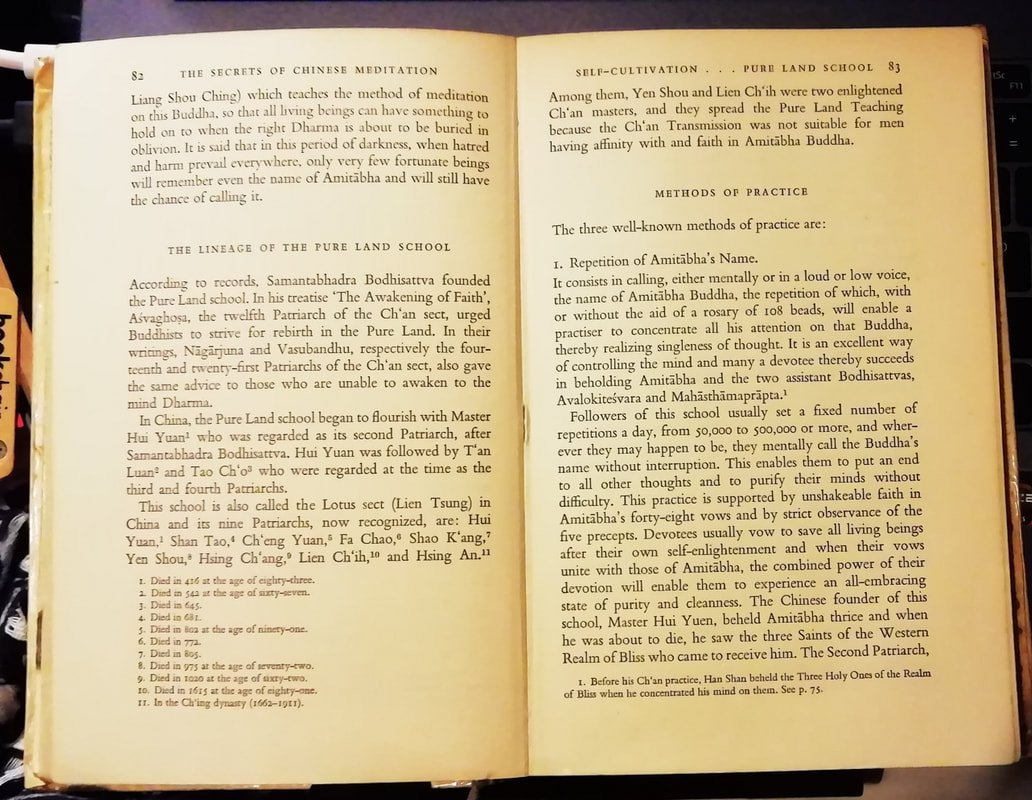
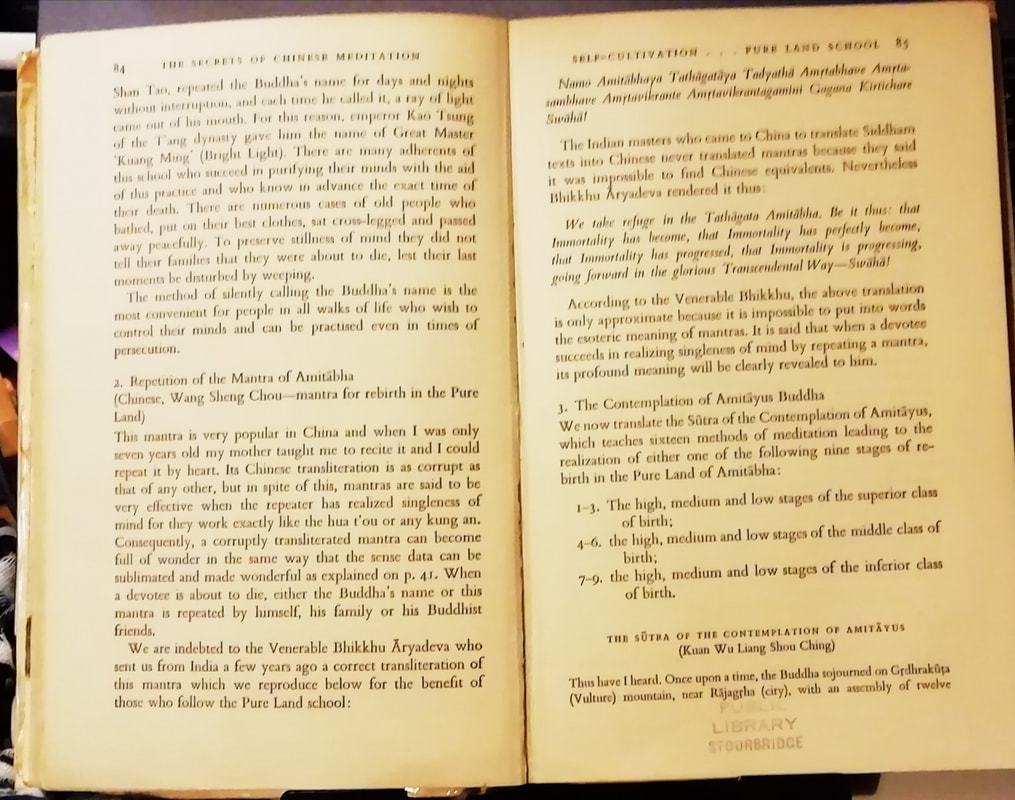
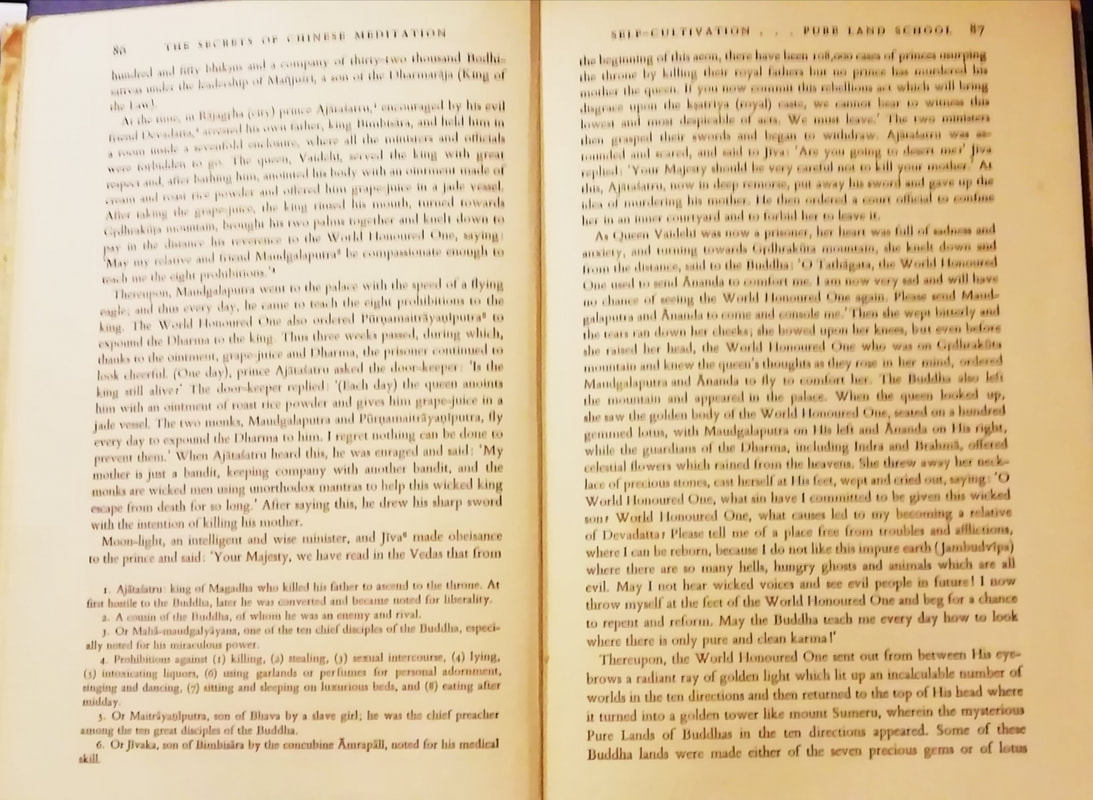
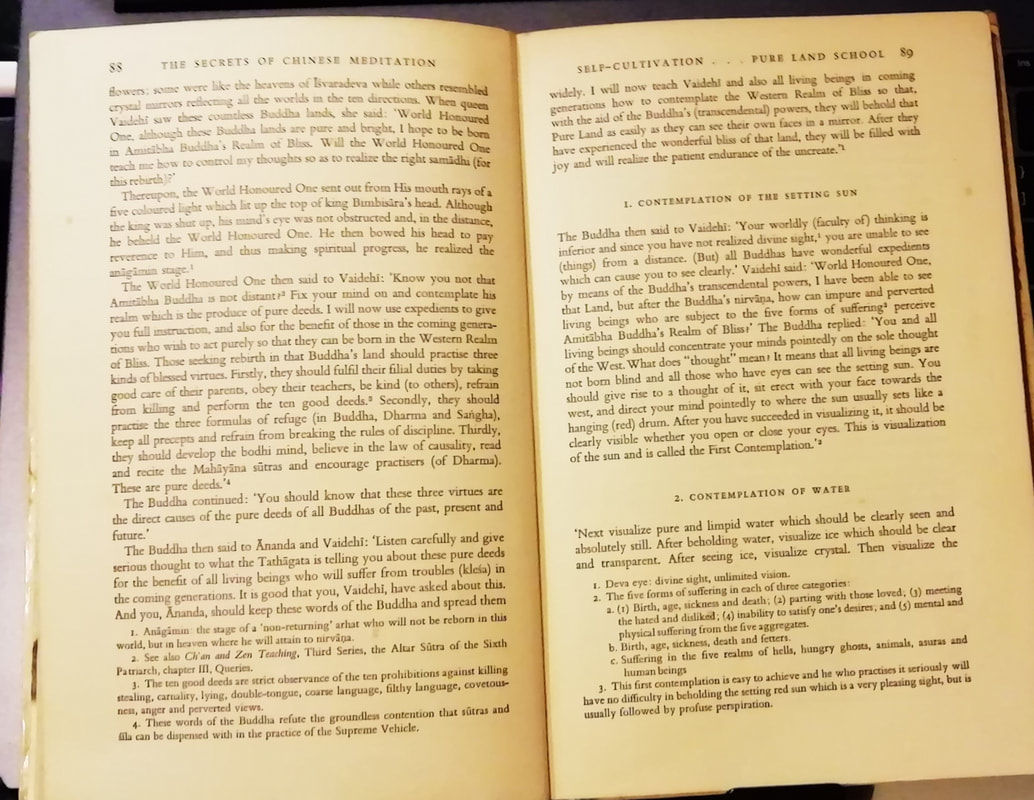
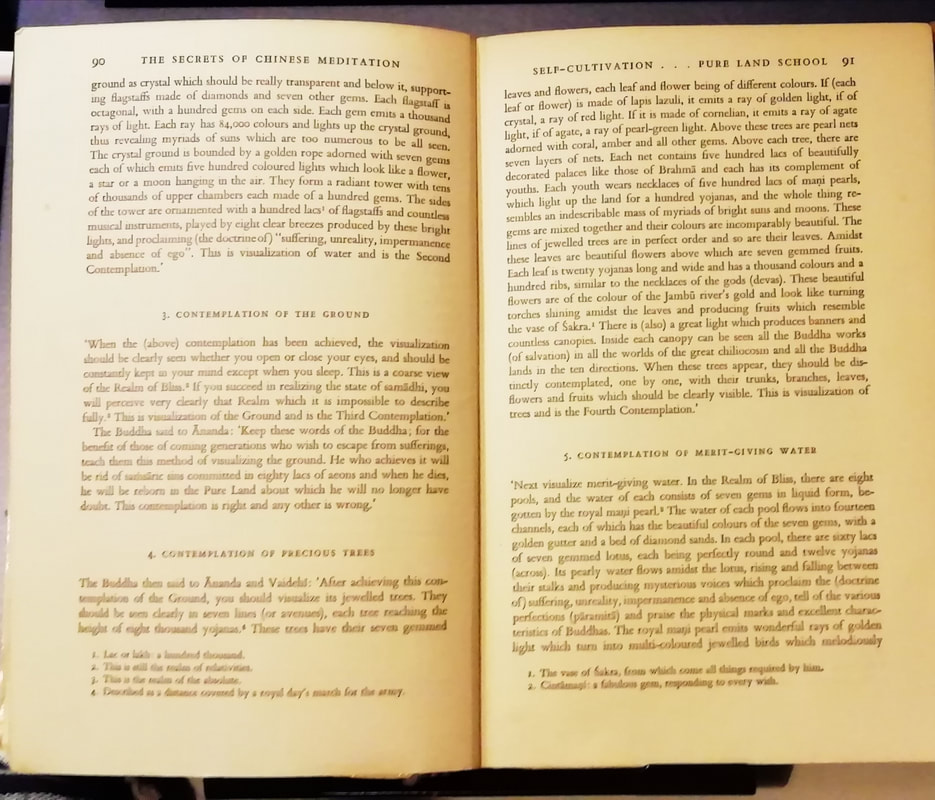
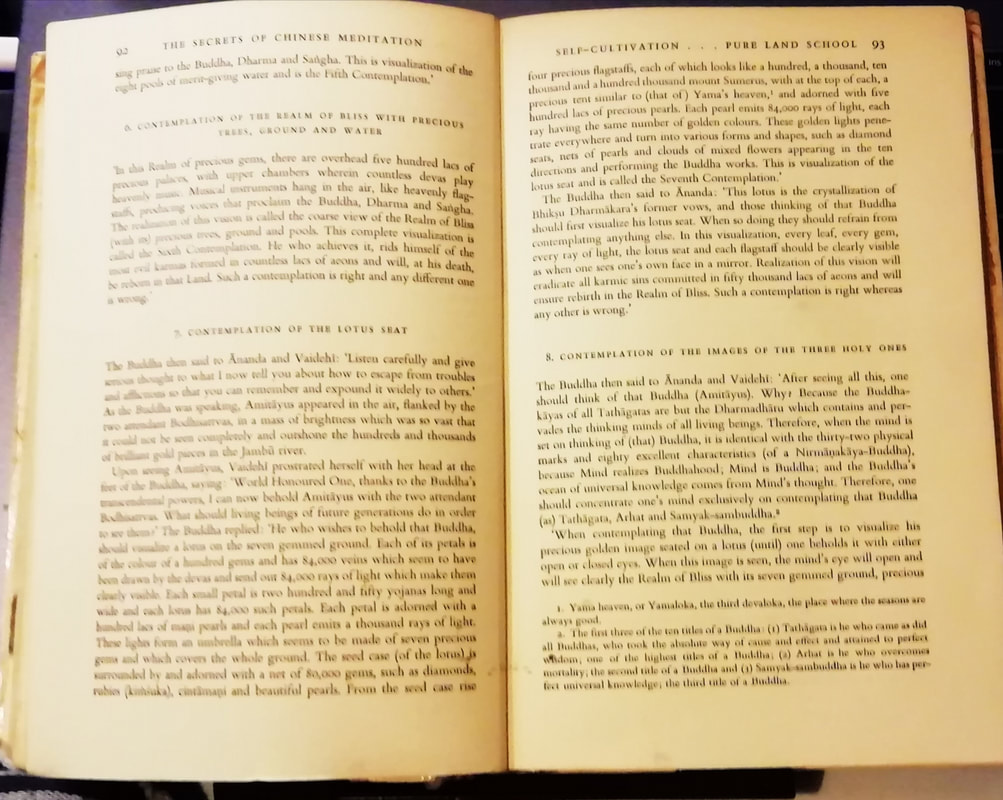
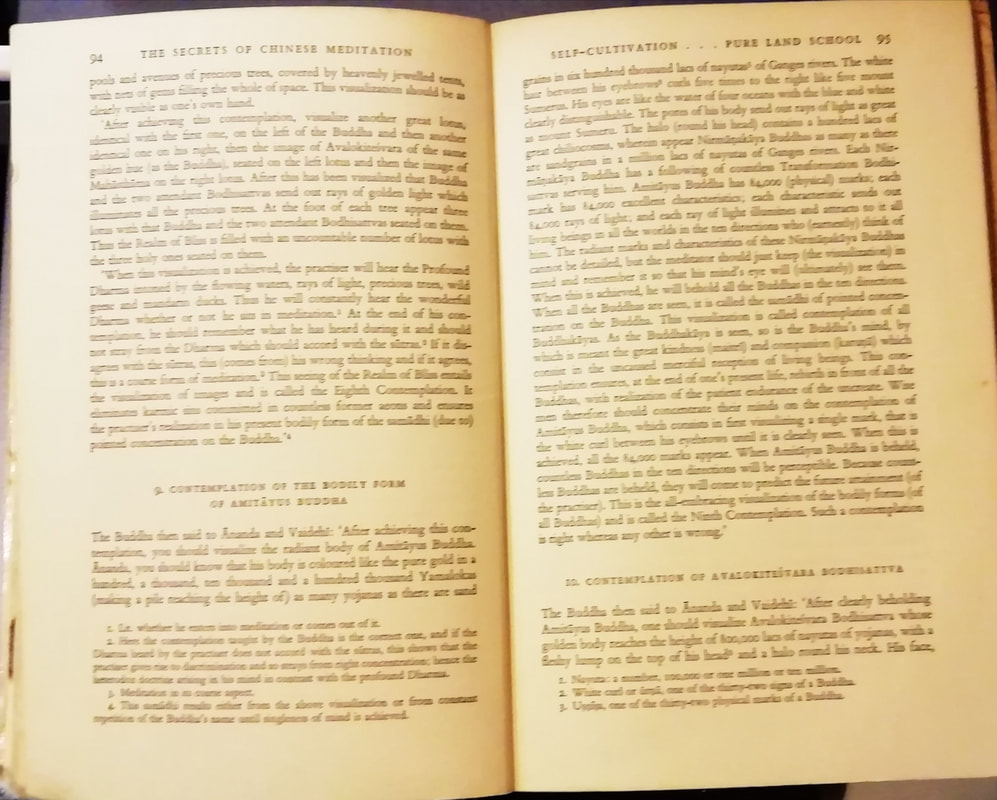
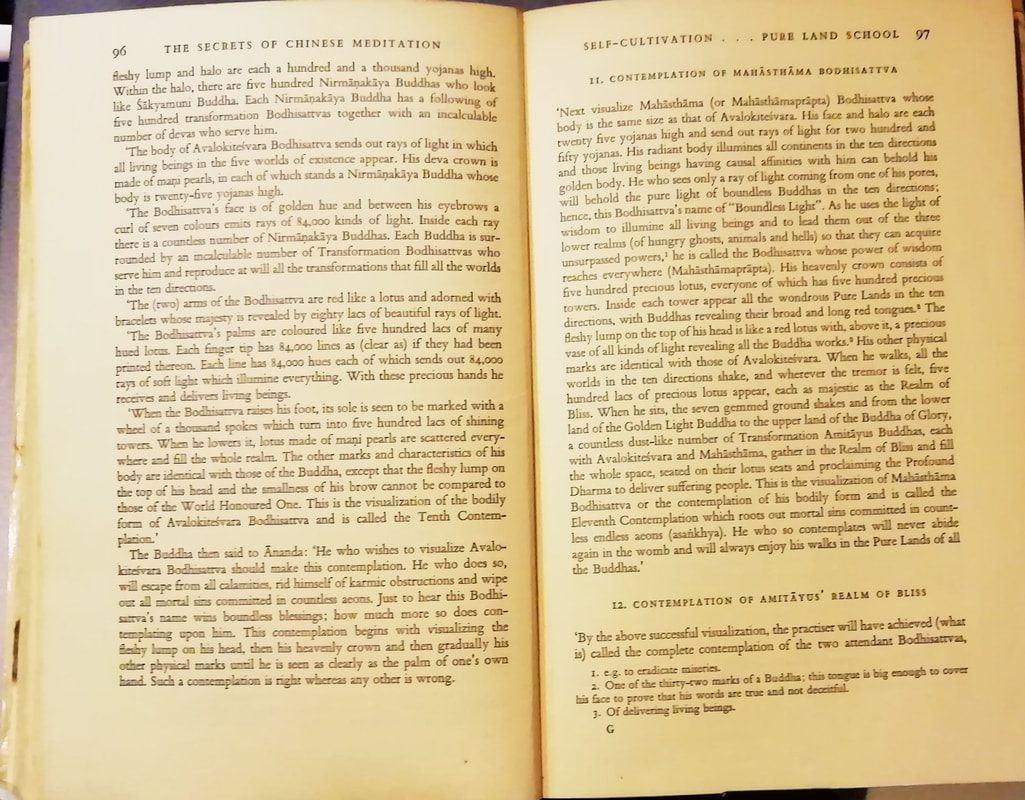
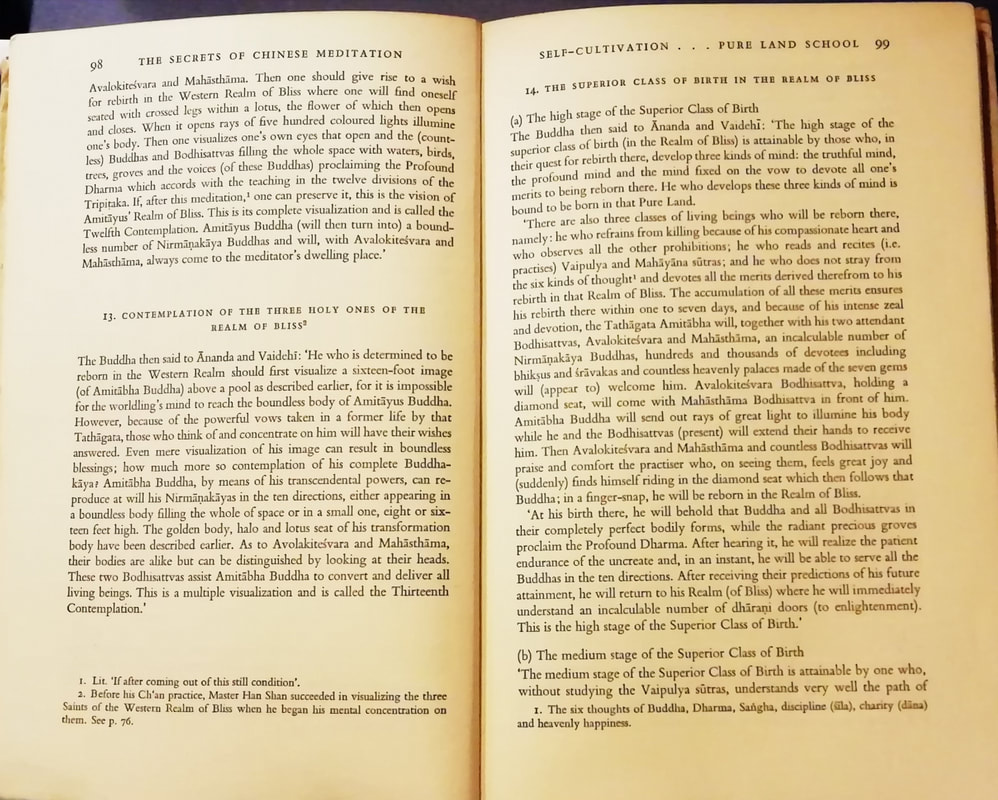
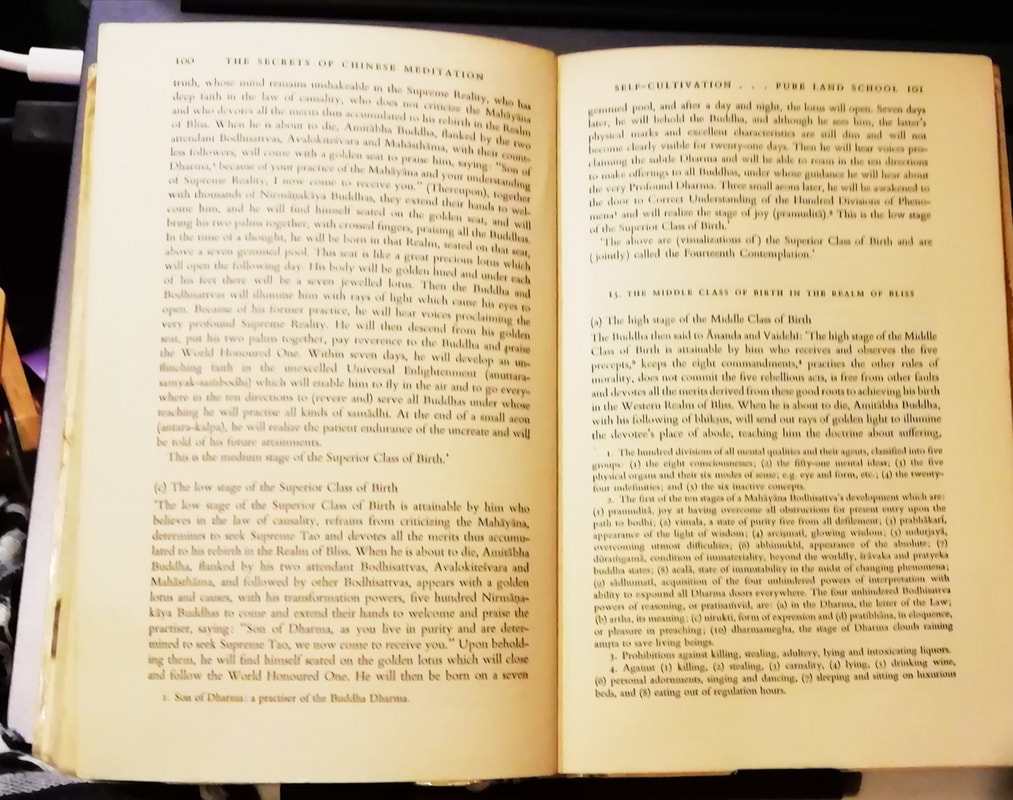
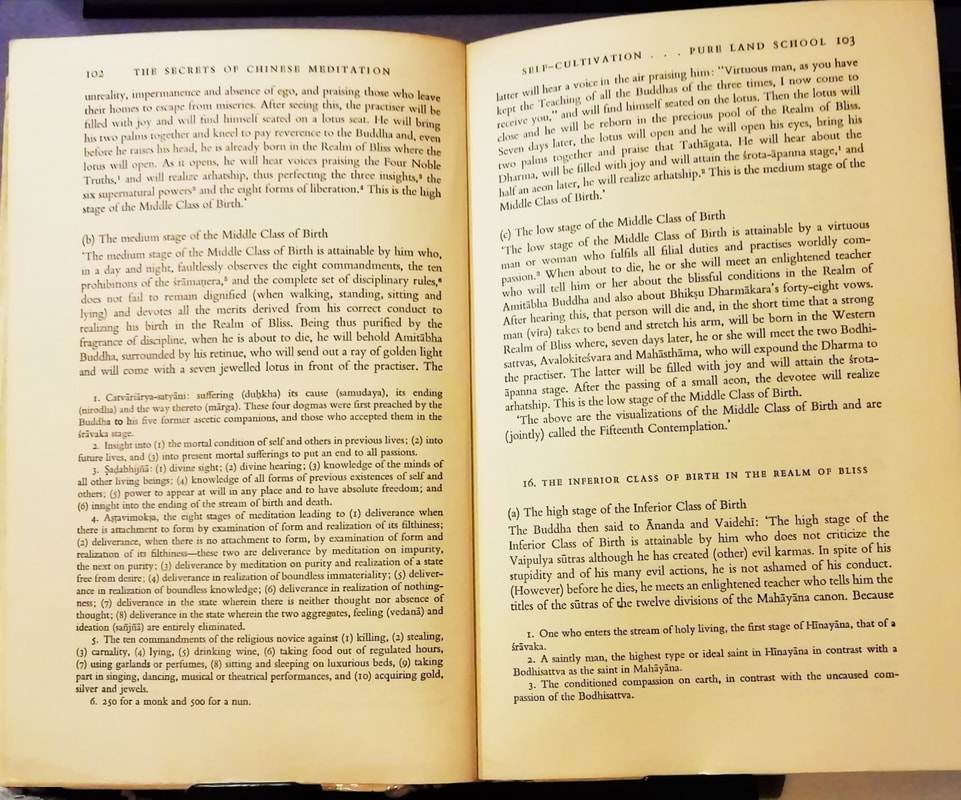
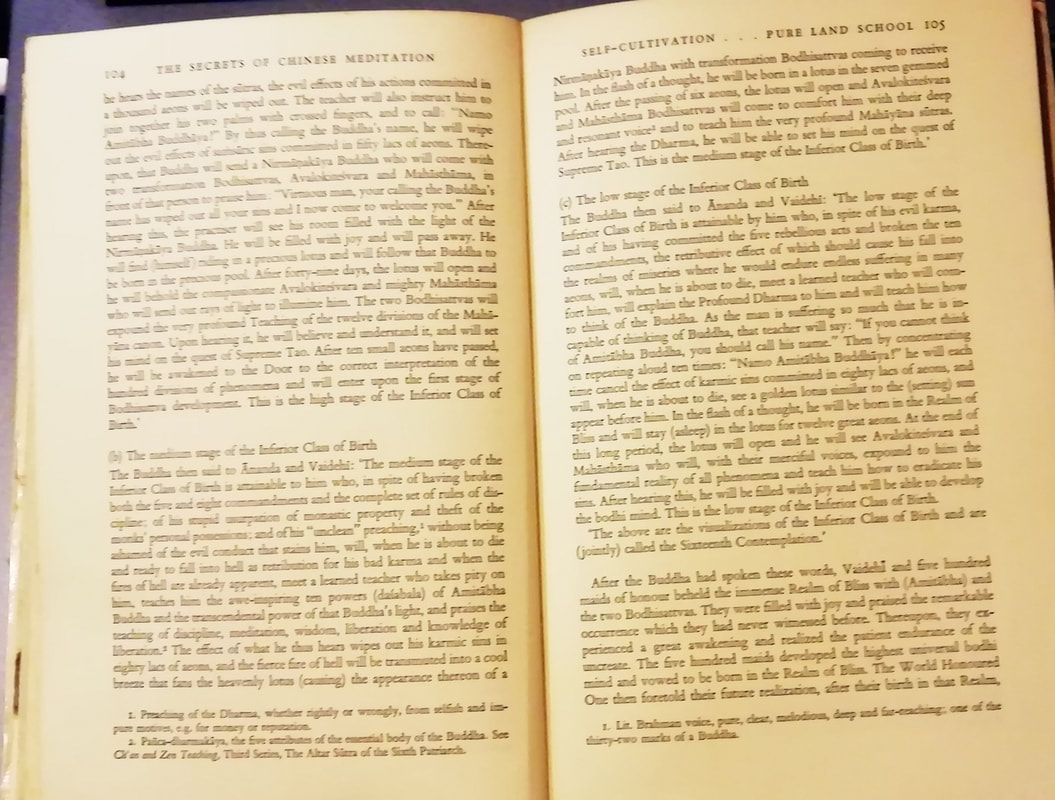
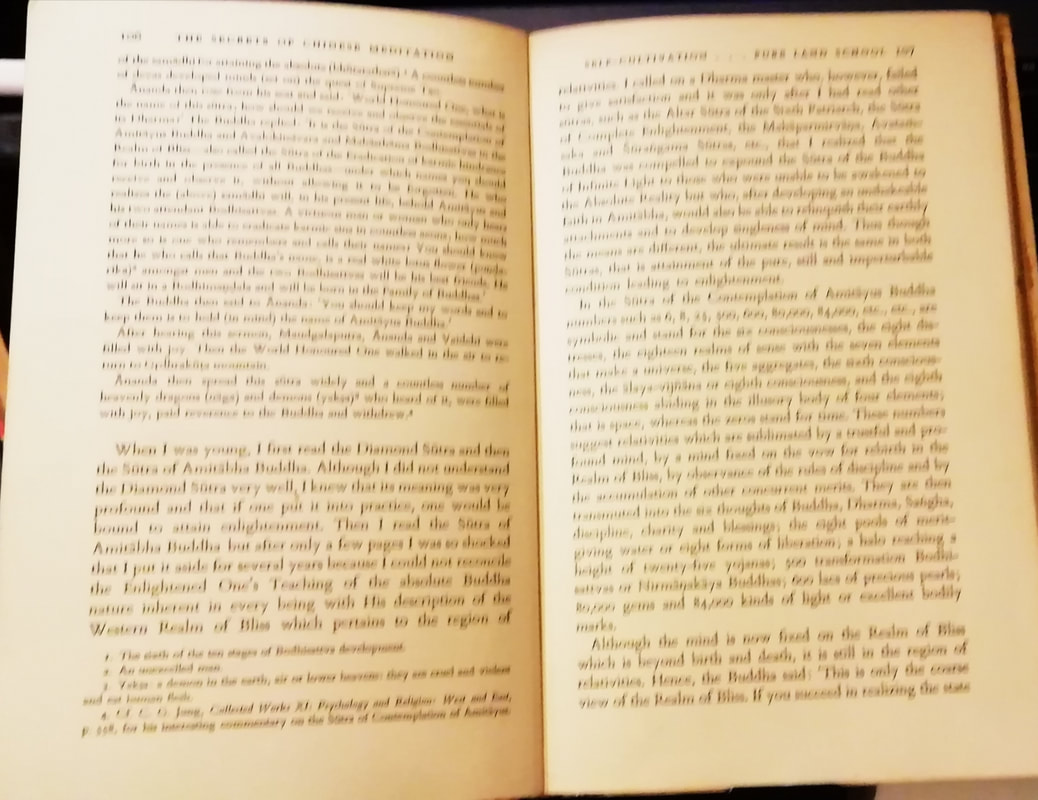
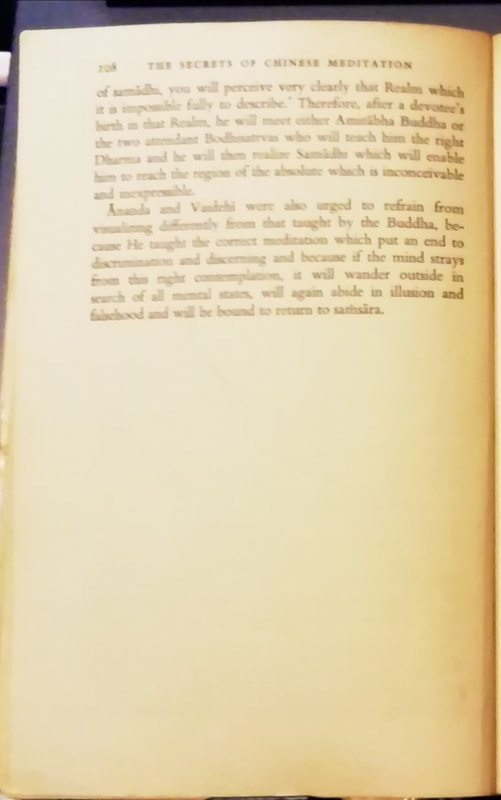
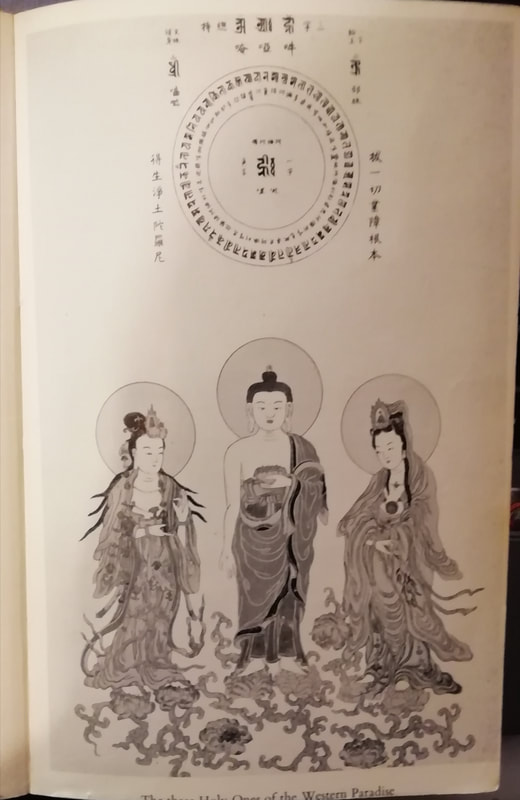
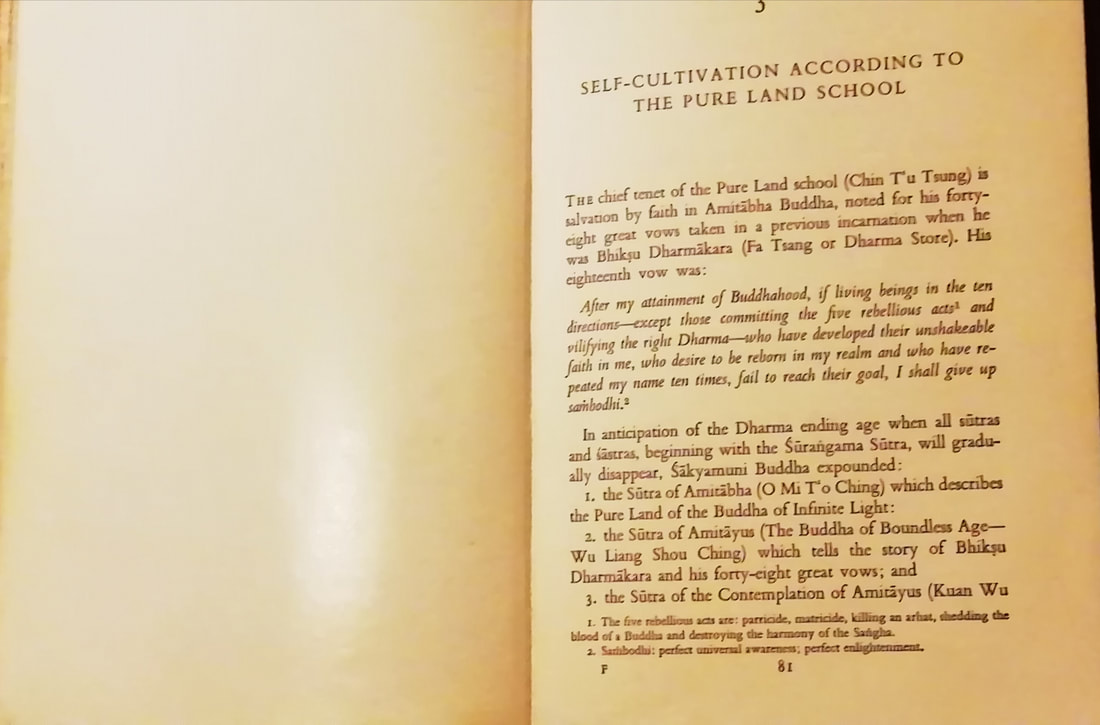
As a number of sincere practitioners have contacted me of late enquiring about the Pure Land Teachings as preserved within China - I have decided to make a simple offering of photographed pages presenting Charles Luk's expert guidance on this matter as recorded in his book entitled 'The Secrets of Chinese Meditation'. I have chosen the original (1964) hardback edition - as quite often later editions were sometimes altered here and there to suit the agenda of various publishers. This is Chapter Three (3) of that book which runs from and to pages 81=108.
|
Archives
October 2025
Categories
All
|
RSS Feed